Publikation
Ants x Interspecies Research Cluster
New Practice in Art and Technology
Englischer Originaltext
Abstract
This paper investigates human-ant relations through the use of technological interfaces. We explore theories of interspecies relationality and develop new methods and practical tools for working with ants, such as live and algorithmic simulations, computer vision tracking, and ant habitats (formicaria). A transdisciplinary approach is used to navigate the multiple layers and perspectives of different living subjects, with the overarching aim of revising how we live and think as part of human and non-human collectives.
Keywords: Ant Colony Optimization, Artificial Intelligence, Collective Behavior, Decentralized decision-making in multi-agent systems, Human–computer interaction, Interspecies Collaboration, Methodologies in Myrmecology, Non-Human Ethics, Practice-based research
Introduction
“I see already, and I see it with pleasure, that you will not content yourself with being a mere collector of insects.” (Kirby & Spence, 1857)
A computer full of bugs. This project began with the idea of building an ant computer. Why program complex digital models of natural behaviour and emergent intelligence when you can just compute directly, using live ants? We never ended up building an ant computer because we realised that it was neither efficient nor ethical. Instead, we discovered that it was more interesting to try and learn from ants, how they navigate, socialise, live, etc., rather than forcing them to conform to our human agenda. Nevertheless, the initial idea of the ant computer already contained three elements that would recur consistently throughout our project: ants, humans and machines.
This text describes our project in as much detail as possible. Our research process involves identifying existing work on interspecies relations across a very wide range of academic fields. Our practical work involves the design, construction and prototyping of various types of ant habitats (formicaria), simulations, sensing and tracking technologies, exhibits, and methods of working and caring for and with the ants. Our critical/theoretical work involves reflecting on what we do and read, especially with regard to interspecies ethics and the roles that we play in interspecies interactions. In this text, these elements are described in a certain order for ease of reading, but it is important to note that we did not work on them in a sequential order. Rather, they were developed in parallel and became entangled during the project.
1.1 About the Interspecies Research Cluster
We are 4 researchers who share a fascination for how animals (human and non-human) relate to each other. Before starting this project, none of us had worked with ants. Our existing skills and academic backgrounds are distributed across the following disciplines:
| Discipline | Subdiscipline |
|---|---|
| Technology | Programming, Digital Fabrication |
| Science | Computational Linguistics |
| Design | Architecture, Formicarium Design |
| Art | Sound art, Artistic Research, Sculpture, Creative Writing, Film |
We decided to adopt an interdisciplinary approach to utilize our diverse expertise. For us, this involves identifying shared areas of interest and concern while maintaining some differentiation in individual opinions and characteristic disciplinary ways of thinking. This approach contributed a certain broadness and multifaceted quality to the project, which we hope becomes apparent while reading this text. Our interdisciplinary approach was further developed through its interplay with our research topic: interspecies relations. Studying relations and interactions between unfamiliar or unknown agents often requires meta ways of thinking. For example, in our daily research, we constantly needed to switch perspectives, both between living subjects (e.g., ant and human), and conceptually, between different practical and theoretical frameworks, approaches, and guidelines.
Working in this way on uncertain footing and between bodies of knowledge and practice is a common characteristic of interdisciplinary working.
1.2 Individual motivations
1.2.1 Mika Rosenberg
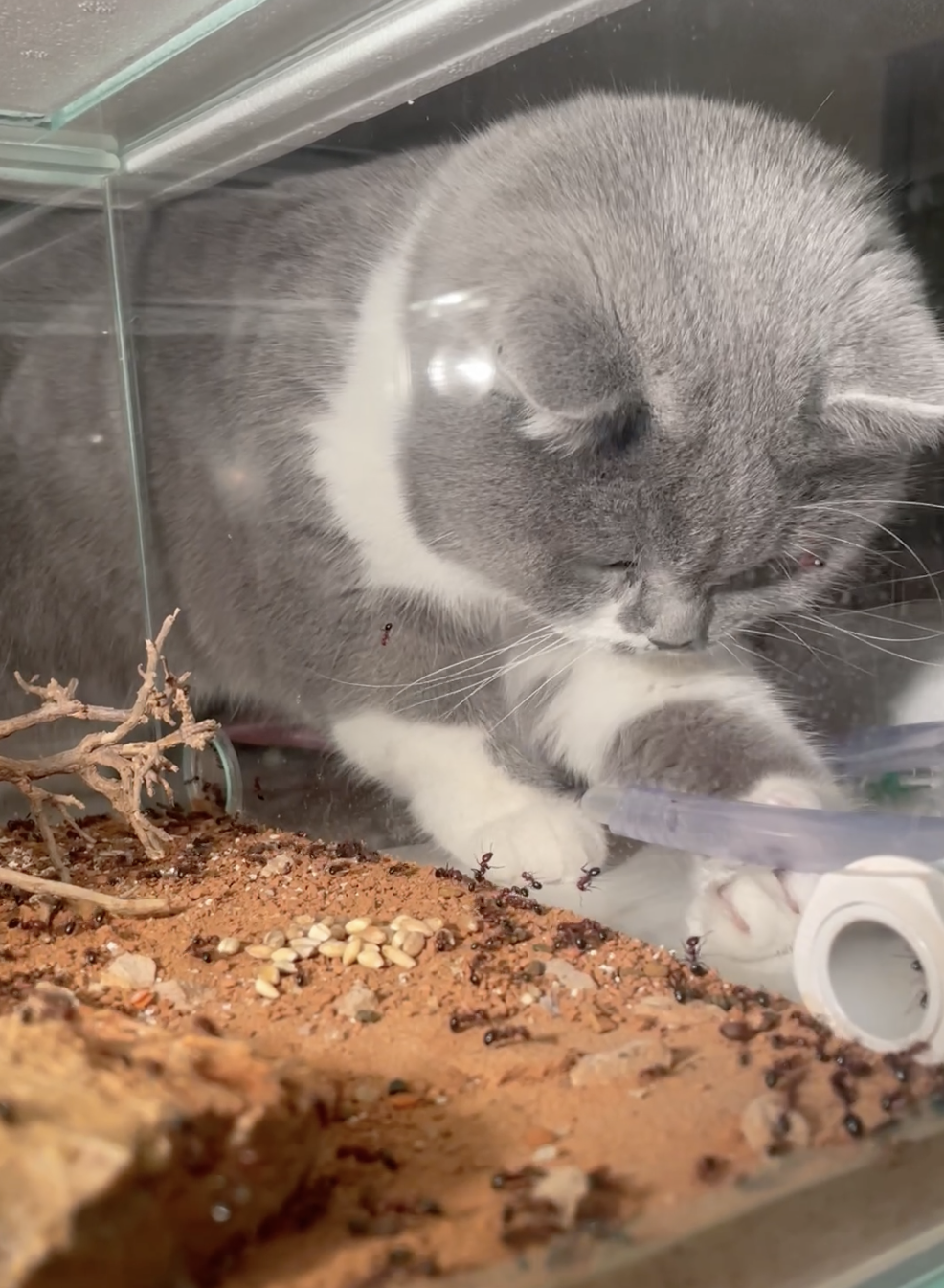
My artistic approach examines ideas around speculative fabulation, cohabitation, coevolution, and kinship with non-human beings. I’ve worked extensively with insect collecting and rearing, and have fostered caretaking practices with butterflies, spirulina, orchids, bees, and cats. Initially, I intended to work alongside my 3,5 kg fluff ball, but studio constraints shifted my focus to ants—a colony of 1000. My cat, Bubbles, eagerly embraced the newly adopted ant "TV" colony.
1.2.2 Lilli-Chiara Kurth
I joined this project because of my curiosity about ants and the role of non-humans in AI-based technologies. I am particularly interested in the language, ethics, and conceptions surrounding the involvement of nature and animals in scientific practices. Overall, I want to investigate exploitative relationships between humans and non-humans and be part of developing new alternative approaches.
1.2.3 Alessandro Mac-Nelly
My initial idea was to build a computer made of ants, inspired by ants’ algorithm-like behaviours and computing machines like Z1 from Konrad Zuse. I wanted to explore alternatives to artificial intelligence and the possibilities of using ants as biological intelligence to work and collaborate with humans.
1.2.4 Max Baraitser Smith
I joined the project because I was interested in what it would be like to work creatively with other living beings. For me, this way of working offers an alternative to "free" human acts of creativity by embracing existing entanglements and relationships. I have been part of many projects working with ecology, but have never worked directly with real living organisms. My background is in sound art, tool/instrument design, programming, and non-hierarchical interdisciplinary working.
1.3 Distribution of tasks
Every step of this project happened collaboratively. Nevertheless, specific individual expertises and motivations emerged over time, resulting in phases of distributed work before coming back together again. We like to think of this distributed collaborative working rhythm as similar to the shifting roles of ants within a colony.
| Tasks | People Responsible |
|---|---|
| Concept creation, exhibition design, video projection, documentation, conducting experiments and workshops, ant care | All |
| Creative writing | Mika, Lilli |
| Reading and research | Mika, Lilli, Alessandro |
| Algorithmic simulation | Alessandro |
| Live simulation | Lilli, Max |
| Formicarium design | Mika, Alessandro |
| Path tracking | Alessandro, Max |
| Communication | Mika, Lilli, Max |
| Outreach and conference applications | Mika, Lilli, Alessandro |
1.4 Our research environment
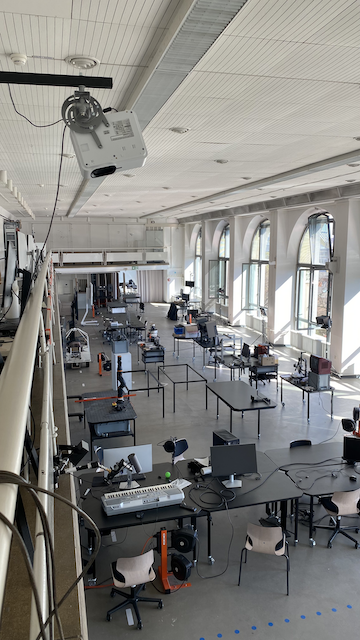
A core element of our study program is the Studio, a large open plan room which originally functioned as the main library of the Berlin Technical University. The studio, filled with tables, chairs and screens, is where students conduct the majority of their work. We are the first research group at Design & Computation to conduct hands-on work in the studio with non-humans. This meant that we were challenged to figure out how non-humans could and should exist within the anthropocentric architecture of the university. Initially, we used a small glass ant cube sitting on a table in the corner of the studio (see Zoo3). By the end of the project, this had grown to be a 2 x 1.6 meter open-air sandbox (see Method 3: Designing a formicarium for ant/human/algorithm comparison). Our fellow classmates were excited and interested in our activities, although this lessened over time as the ants became part of everyday life in the studio. During the project, we reflected extensively on the differing needs of ants and humans in shared creative working spaces, as well as practical risks, such as people stepping on the equipment, or the ants escaping their nest and damaging other people’s projects and personal belongings. The studio was our home-base for discussing and building the project, including caring for the ants.
1.5 Aims of the project
1.5.1 Discovering new ways of interacting, living and thinking with other humans and non-humans
The presence of non-humans in our everyday lives and culture is often characterized by a kind of distanced fascination, e.g., in the case of wildlife documentaries, zoos, and sometimes even pets. In this project, we shift the focus away from non-humans as isolated organisms that are observed from a distance, and towards the interactions between mixed groups of humans and non-humans. This shift is motivated by the ecological crisis, which we argue is also in part a crisis of human/non-human relations. This is especially true between different scales, e.g. humans vs ants vs microorganisms. It is not a problem of language barriers, which could be solved by smart translation technologies, but rather a problem of deep understanding and connection. How do humans conceive of other organisms’ identities and life worlds? Most existing research in this field has concentrated on animals with brain sizes comparable to those of humans, such as apes, elephants, and dolphins. However, we believe it is equally important to study our relationship with animals that are very different from us. This exploration can challenge and enrich our understanding of fundamental human concepts like individuality, society, and consciousness.
1.5.2 Assembling existing terms and types of interspecies relationships
Starting this project, we lacked the tools and vocabulary for describing different ways of relating to non-humans, and the practical steps required to build such relationships. In State of the Art, we try to identify key terms from several different academic fields to describe interspecies relationships. We attempt to understand these terms in a way that avoids anthropocentrism as much as possible. This is a tricky goal, since avoiding anthropocentrism itself contains a paradox of the human trying to escape its own existence, e.g., its human-ness. Nevertheless, we try to be aware of this and find our own ways of dealing with it within the specific situations and contexts which it arises.
1.5.3 Revising existing and developing new cultural, scientific and technological practices and representations of ants
Multiple histories of ant-human relationships exist within cultural, scientific, and technological spheres (see State of the Art). We aim to unpick these histories, looking particularly at their motivations, practices, and key assumptions about ants and humans. From there, we consider how new thinking on interspecies relationships fits into these practices. We ask ourselves which practices and modes of representation can be considered outdated, and which can be considered productive and progressive. In some cases, this necessitates stricter ethical guidelines, but most of the time it involves reconsidering our basic assumptions about, and expectations of other animals, e.g., in the aestheticization of animals in zoos and museum exhibits, or the extraction of navigation algorithms from ants’ pheromone behaviors.
1.5.4 Integrating non-humans more deeply into creative and design processes
In the early stages of this project, we experimented with placing the ants next to us on the table whenever we discussed the project. This initial attempt to integrate the ants more deeply and make them more present in our work process was a nice experiment, but it does not constitute the extent of integration that we imagine. All creative and design processes involve engaging with things, such as computers, architectural environments, roads, toothbrushes, etc. We take inspiration from Bruno Latour in his consideration of non-humans, things, quasi objects, and hybrids all as potential agents/actors (Veldman, n.d.). Extending this thought, we hypothesize that the agentile quality of things makes interspecies relations potentially relevant in any scenario that involves dealing with something other than ourselves. From this perspective, interspecies relations are not only relevant to creative and design processes which deal specifically with non-humans, but rather to all areas of creativity and design.
1.5.5 Utilising technology as interspecies interface
We see potential in new technologies for mediating and interfacing with non-humans. Scaling is one method which is used extensively throughout this project, due to its ability to forge links, metaphors, and analogies, and address the sensory gap between humans and ants. Let’s take an individual human and an individual ant as an example. At first, they do not seem to have much in common with each other. However, after adjusting the scale, e.g., with 100 humans and 100 ants, surprising points of similarity emerge in terms of movement and interaction. Rather than multiplying the number of humans, we could also conceptually divide the single human, viewing it no longer as an individual, but rather as an ecosystem of around 33 billion microorganisms. When compared with the original 100 ants, this scale produces further insights. It raises questions about whether we should think of the ant colony as a single organism, like the human individual, or a group of individuals, like the microorganisms that make up humans. By using digital tools for identifying, modifying, and rescaling ant and human qualities, we hope to find new methods of mediation and interfacing which have not been possible in the past.
This approach brings with it several challenges relating to representation. Digital representations are rigid in the sense that what cannot be detected or registered digitally simply does not exist for the computer. In this project, we deal with sensory experiences, social interactions, and emergent consciousness, none of which have straightforward digital counterparts. The fundamental question is therefore about whether technology can bridge worlds which exist outside of itself, or if these worlds lose their meaning once they are collapsed into the digital universe.
State of the Art
In this chapter, we present work from other researchers on the subject of interspecies relations. Our search topics include: Scientific papers dealing with ants or interspecies relations; Creative works from artists and designers which involve ants, other animals, or the inversion of scientific methodologies; Books by scientists, historians of science, ecologists or philosophers dealing with interspecies relations. We also immersed ourselves in ant culture, visiting the Ant Store Berlin multiple times, and following the presence of ants on social media, games, and movies.
The result is a set of examples from a wide variety of academic fields and research contexts. We hope that this gives the reader an idea of the overall research landscape and what inspired us to conduct this project. It is important to point out that this list is not comprehensive. Most sections only scratch the surface in their respective fields, and are potential doorways to whole worlds of thought and practice which cannot all be mentioned in this text.
2.1 Myrmecology
| Scientific Field | Definition |
|---|---|
| Myrmecology | Study of ants |
| Entomology | Study of insects |
| Zoology | Study of animals |
2.1.1 Deborah Gordon
Deborah Gordon is a professor of Environmental Biology at Stanford University, focusing on ant colonies and behavioral ecology. She studies ant behavior using a combination of field observations, controlled experiments, and computational models to understand how colonies function without centralized control. In the field, she marks individual ants with paint or tiny numbered tags to track their movements and roles, mapping colony locations using GPS and hand-drawn nest maps over long periods. She records environmental factors such as temperature, humidity, and soil conditions, correlating them with foraging behavior. By removing individuals or worker groups, she examines how colonies reorganize tasks in response to change. Her controlled lab experiments isolate specific behaviors, such as recruitment and decision-making, in artificial nests. Gordon also applies network analysis and mathematical models to quantify how simple ant interactions give rise to complex collective behavior (D. M. Gordon, 2023b), using video analysis and statistical tools to measure trail formation and task allocation. Through these approaches, she demonstrates how ants regulate foraging, territory defense, and colony coordination through decentralized processes rather than hierarchical leadership.
In Ants at Work, D. Gordon gives an account of her work studying the red harvester ants in the Arizona desert (D. Gordon, 1999). Harvester ants are a genus of ant that mostly eat seeds (rich in water) and the occasional insect. They inhabit mostly dry, hot climates and deserts. In the book, Gordon describes her days in the field and lab as she and her team apply their methods to the landscape. She distinguishes between three distinct levels of ant organization: the ant, colonies, and populations. Gordon describes the life cycle, reproduction, age, and maturity of colonies, and interaction within the colony and neighboring colonies, affecting foraging patterns with the changing weather and landscape; details about methods in the field and the laboratory colonies. She concludes with the sentiment that the more she studies ants, the more she feels insignificant to them and that there may be little use in modeling them for human social structures based on a myopic view. Every behavior should be seen as the product of a complex web of connections within the whole system, rather than a set of isolated parts.
2.1.2 Measuring activity in ant colonies
The paper Measuring activity in ant colonies (Noda, Fernández, Pérez-Penichet, & Altshuler, 2006) presents an infrared batterypowered sensor design for monitoring ants. By placing the infrared ring at nest entrances/exits, the authors can monitor "speed" of the colony, e.g., changes in incoming/outgoing traffic over long periods. This paper informed our discussions about sensing techniques, particularly the choice between analog low-tech sensing (e.g., drawing ant paths by hand, or with sensitive paper), local electronic sensors (e.g., the infrared ring, pressure sensors, light sensors), and topdown/global sensors (e.g., computer vision tracking). The tracking methods which we developed are described in Comparing Ants, Humans and Algorithms, Method 4: Tracking ants.
2.1.3 Measuring ant colony size
The paper A comparison of mark–release–recapture [MRR] methods for estimating colony size in the wood ant Formica lugubris (Y.-H. Chen
& Robinson, 2013) evaluates destructive (excavation) and non-destructive (MRR, measuring basal area or volume of nest mound) methods for determining ant colony size. Colony size correlates with the lifestyle and habitat of that specific colony, allowing for conclusions to be drawn about their health, competitive abilities, and foraging behavior. We draw inspiration from this discussion for our approach to measure the health of our own colonies in Comparing Ants, Humans and Algorithms, Method 5: Measuring ant activity and colony health.
2.2 History of science
The scientific history of entomology (the study of insects) and myrmecology (the study of ants), has its roots in European colonialism and echoes the terminology of this period. Colony, queen, worker, army and drone function as ambiguous terms, referring to both social insect organization and European imperial possessions. These terms are not easy to replace because they are cemented within our culture and bound to representations of the ant society.
Charlotte Sleigh is a British professor of Science and Technology Studies whose research explores ants and historical developments within myrmecology. Her work investigates underlying issues within scientific and natural history practices, emphasizing that the study of ants has consistently served a dual purpose, both advancing scientific knowledge and reflecting human self-understanding. In Empire of the Ants Sleigh (2001), Sleigh examines how H.G. Wells’ 1905 short story of the same name reflects early 20th-century anxieties about colonialism, degeneration, and insect intelligence. Drawing on contemporary myrmecological research, Wells imagines hyper-intelligent ants as a metaphor for the destabilization of European imperial control. Sleigh situates this within the entomological studies from that period, showing how tropical ant species—often perceived as pests—became entwined with colonial fears of disorder and resistance. She argues that ants became proxies for indigenous populations within European colonial conquest, noting that “both numerical excess and psychology were used to construct the colonial ant and the colonial human; an otherness of man was figured in the ant colony” (Sleigh, 2001) ( p. 44). This construction of ants as colonial organisms relied on narrative techniques such as multiplication (vast swarms), isolation (alone within a foreign self-contained society or nature/culture), and scaling (either miniaturization, reinforcing control, or gigantism, evoking uncontrollable menace). These strategies shaped natural history’s framing of both ants and colonized peoples, reinforcing notions of threat, alterity, and an inherent resistance to European dominion. This account of scaling is related to the account given by Susan Stewart in On Longing: Narratives of the Miniature, the Gigantic, the Souvenir, the Collection. Stewart says that “our impulse is to create an environment for the miniature, but such an environment is impossible for the gigantic: instead the gigantic becomes our environment, swallowing us as nature or history swallows us”(Stewart, 1993). In this context, colonial narratives rendered indigenous societies—human and non-human—either as reducible specimens—manageable and contained—or as overwhelming forces, mirroring the tension between scientific control and colonial anxiety.
In Six Legs Better(Sleigh, 2007) Sleigh offers a cultural history of myrmecology from 1874 onwards, tracing how ant research evolved in relation to social and scientific thought. Sleigh explores the contributions of Auguste Forel, William Morton Wheeler, and Edward O. Wilson, arguing that these scientists projected contemporary intellectual and political concerns onto ant societies. Forel’s late 19th-century work framed ants through a psychological and socialist lens, emphasizing their behavioral flexibility. Wheeler’s superorganism theory (1911) reflected early 20th-century organicist and holistic biology, treating colonies as single entities. Wilson’s sociobiology (1975) marked a shift towards gene-centered explanations of ant behavior, paralleling the rise of reductionist approaches in biology, particularly through genetic and chemical communication (pheromones). Through this analysis, three cycles of metaphorical models are formed through the use of the ant: the human mind (Forel), human society (Wheeler), and human/nonhuman communication (Wilson) (Ellison & Gotelli, 2021).
In Ant Sleigh, Sleigh examines the cultural symbolism of ants, illustrating how they have represented both utopian cooperation and dystopian collectivism. From Aesop’s fables to Cold War sci-fi films, ants have been variously depicted as industrious workers, communist threats, dehumanized automatons, and models for technological efficiency. Sleigh argues that these shifting representations reveal deep-seated human anxieties about individuality, control, and social cohesion.
In 2025, Sleigh published the essay How Ants Made Sociobiology (Sleigh, 2025), demonstrating how mid-20th-century cybernetics and organicist traditions influenced sociobiology. She argues that ants played a foundational role in the development of sociobiological thought, providing the key empirical challenges, such as explaining altruism and collective behavior, that shaped theories like kin selection and inclusive fitness. Sleigh also traces how cybernetic models of ant communication, such as pheromone-based information systems or Ant Colony Optimisation algorithms (ACOs), influenced self-organization theories and swarm intelligence, which later informed fields like network science and artificial intelligence. Due to the recent release of this essay, it was not included in our preliminary review, but is still of great relevance to this project.
2.3 Philosophy and (applied) ethics
2.3.1 Critical posthumanism and new materialism
Critical posthumanism is a contemporary branch of philosophy that diverges from humanist tradition by challenging anthropocentrism—the view that positions humans as separate from and superior to "nature." Building on post-structuralist and feminist critiques, critical posthumanism seeks to decenter the human subject. New materialism complements this approach by recognizing matter’s active agency and rejecting human-centered perspectives. Together, these frameworks dismantle conventional divides between nature/culture, subject/object, and human/non-human entities.
Critical posthumanism and new materialism both have strong historical ties to the natural sciences. Donna Haraway (biology and feminist theory) began dismantling anthropocentric epistemologies through her research into complex systems that defied traditional analytical frameworks. Ant researcher Deborah Gordon exemplifies this approach, demonstrating how collective behavior emerges from interactions without centralized control. Gordon has credited Haraway for providing a vocabulary to articulate her discomfort with reductionist scientific methods that prioritize individual components over systemic connections (D. M. Gordon, 2010). One of Haraway’s core insights is that objectivity is always partial and embodied. She argues that knowledge emerges through situated interactions rather than existing as external truth imposed on a passive world. This perspective not only challenges the superiority of human cognition, but emphasizes knowledge’s co-constructed nature across species boundaries. Haraway extends this argument by foregrounding multispecies relationships as central to world-making through concepts like natureculture (D. Haraway, 2016) (D. J. Haraway, 2003), which embodies her thesis that seemingly separate domains, e.g. nature and culture, are inseparable. Her concepts of kinship and significant otherness propose an epistemology rooted in collective processes of becoming, demanding that knowledge production account for more-than-human participants and their agencies.
2.3.2 Symbiosis
In Ants (Hymenoptera: Formicidae) and humans: from inspiration and metaphor to 21st-century symbiont, Ellison and Gotelli present a review of instances where physical/cultural symbiosis has emerged between humans and ants. They adopt a biological definition of physical symbiosis and extend it to cultural symbiosis in order to categorize different types of relationships between humans and ants. The authors apply terms describing various symbiotic relationships and chart them based on different effects – positive, negative and neutral – between the two species, aligning with Haraway’s concept of natureculture. Inspired by Ellison et al.’s relational framework, we chose to prioritize relationships where ants, humans and later on algorithms, would be affected in a positive or neutral way. This led us to focus on two types of relation: mutualism, a symbiotic relationship where all species involved benefit from their interactions, and commensalism, an association between two organisms in which one benefits while the other neither benefits nor is harmed. This thinking was the basis for the ethical guidelines which we used in our field and lab work (see Appendix, figure 23).
2.3.3 Shared arenas of sensation
Shared arenas of sensation is a concept from Diane Keeling’s Feral Rhetoric: Common Sense Animals and Metaphorical Beasts (Keeling, 2017), where she reframes interspecies interaction through the lens of shared sensory experience. Drawing from Aristotle’s notion of sensus communis, a perceptual faculty shared by all animals, Keeling argues that interspecies cohabitation becomes possible when enough sensory overlap exists.
These shared arenas include sound, scent, taste, temperature and other embodied cues through which animals – including humans – navigate their environments.
Keeling contrasts Aristotle’s inclusive view with Cicero’s human-exclusive notion of common sense, suggesting that the humanist tradition’s adoption of Cicero contributed to an anthropocentric understanding of perception and communication. By revisiting Aristotle, she opens space for theorizing a version of common sense that allows for communication and sociality across species lines. Central to her argument is the idea that domestication is bidirectional: just as humans shape animal behavior, animals also shape human sensory and social habits. Keeling uses the example of feral children raised by wolves to illustrate how shared arenas of sensation enable mutual domestication. These cases suggest that common sense is not fixed but emerges relationally through cohabitation. Keeling states that “Interspecies interaction occurs through a shared arena of sensation ... similar to how humans domesticate nonhuman animals, non-human animals are able to domesticate humans.” (Keeling, 2017, p. 235). She goes on to propose zoomorphism as a mode of interspecies rhetoric, understood not as projection, but as metaphorical transformation. If we remove the assumption that metaphor follows logos, then animal vocalizations and behaviors may themselves operate metaphorically through associative patterns which are recognizable across species. This challenges the anthropocentric impulse to explain animals only in human terms and instead foregrounds multispecies common sense as a space of mutual perception and meaning-making.
Finally, Keeling links domestication to ecological entanglement through the etymological overlap between domus and oikos, suggesting that shared environments create the conditions for multispecies sensory alignment. Her framing of shared arenas of sensation not only troubles the boundaries between species but also rethinks rhetoric itself as an interspecies practice rooted in the senses.
2.3.4 Interspecies IO
Interspecies IO (Interspecies Internet, n.d.), or the Interspecies Internet, is a think tank dedicated to accelerating interspecies communication through technological interventions. Their mission revolves around developing interfaces that seek to create communication pathways between species and methodologies to decipher organic non-human communication. Their work is driven by the view that technological advancements can foster conservation efforts, improve animal welfare, and deepen human empathy, compassion, and ecological understanding. Interspecies IO stands out as one of the few digital and internet-focused initiatives that actively celebrates researchers in the natural sciences who prioritize organic non-human perspectives.
2.4 Linguistics
The scientific terminology for describing ants was introduced by the naturalist William Gould in 1747, when he published the first scientific paper on ants: An Account of English Ants (Gould, 1747). His choice of terminology is based on his observations and personal interpretations of ant behavior, which are greatly influenced by the nature and values of British society in the 18th century. Most notably, he establishes the terms Colony, Worker, and Queen: “A Colony of Ants, from the latter End of August, to the beginning of June is usually composed of a large Female and various companies of Workers. We may by way of Eminence, as well as in Regard to the Honours paid Her by the Society, title the former, the Queen.” (Gould, 1747) Gould’s choice of colonial terminology stuck, and became the standard used by naturalists, entomologists and myrmecologists until very recently. Choosing terminology that carries heavy implications about the referent introduces the danger of mischaracterization and obscuration. This has been criticised in the myrmecological literature, for instance by D. M. Gordon. The monarchic and feudal character of Goulding’s terminology projects human social structures onto ant society, prompting an expectation of ant reasoning and behavior that is scientifically unfounded. “In whatever Apartment a Queen ant condescends to be present, she commands Obedience and Respect. A universal Gladness spreads itself through the whole Cell, which is expressed by particular Acts of Joy and Exultation. They have a peculiar Way of skipping, leaping, and standing upon their Hind Legs, and prancing with the others. These frolicks they make use of, both to congratulate each other when they meet, and to show their Regard for the Queen. Some of them gently walk over her, others dance round her, and all endeavour to exert their Loyalty and Affection. She is generally encircled with a Cluster of Attendants who, if you separate them from her, soon collect themselves into a Body, and enclose her in the midst. However romantic this Description may appear, it may easily be proved by an obvious Experiment. If you place a Queen Ant with her Retinue under a Glass, you will in a few Moments be convinced of the Honour they pay, and Esteem they entertain for her.” (Gould, 1747) While the discrepancies between ant terminology implications and actual behavior are part of the myrmecological discourse, the basic caste terminology has not been updated. We are critical of this, and addressing this gap is one of the motivations for writing Futuristic Ant Fiction (see Appendix, figure 24).
2.5 Computer science
2.5.1 Algorithmic modeling of ants
The Ant Colony Optimization (ACO) (Dorigo & Di Caro, 1999) algorithm is commonly used to solve discrete combinatorial optimization problems, such as the Traveling Salesman Problem, where solutions require selecting the best combination from a vast number of possible combinations. The algorithm iteratively explores possible solutions by simulating ant-like behaviour, utilizing virtual "pheromones" that evaporate over time to reduce the attractiveness of less promising paths while reinforcing better paths with additional pheromone deposits. This mechanism ensures a balanced trade-off between exploration (searching broadly) and exploitation (refining promising solutions).
2.5.2 When does a biological system compute?
The paper When does a biological system compute? (Horsman, Kendon, Stepney, & Young, 2017) explores possible criteria for understanding biological systems as computers. Taking bacteria and DNA as examples, the authors use abstract representation theory to describe the relation between the physical bacteria or DNA polymer, and abstract objects, such as mathematical signal chains or logic gates, in representational terms. This paper helped us to clarify what it would mean to create an ant computer (the initial goal of our project), as well as introducing an approach to linking abstract and physical layers, which informed our implementation of encoding and decoding (see Zoo3). Horsman et. al also provide the following words of caution with regard to anthropocentrism: “it is always possible for an external observer (e.g. us) to impose a post hoc abstract representation on the physical system that is not itself part of how the system is operating. We must avoid smuggling ourselves in as representational entities ‘through the back door” (Horsman et al., 2017)
2.6 Complex systems
The study Comparing cooperative geometric puzzle solving in ants versus humans (Dreyer et al., 2025) explores the dynamics of cooperative problem-solving by examining how groups of ants and humans approach identical geometric puzzles. The researchers create a physical representation of the pianomovers problem, and compare problemsolving skills and performances with different group sizes, ranging from individuals to various group configurations.
In the study, ants solved geometric puzzles more effectively in larger groups by using emergent memory and boundary-following heuristics. Humans, in contrast, excelled individually but experienced coordination challenges when working collaboratively. While human groups maintained individuallevel performance with unrestricted communication, their effectiveness dropped significantly when communication was restricted. These differences highlight ants’ capacity for collective problem-solving versus humans’ reliance on individual cognition and alternative heuristic strategies.
This study gained widespread attention through viral dissemination of its comparison video, which is an interesting case of scientific research on ants reaching a broader public audience. The paper’s use of puzzles and games, using scale to bridge the gap between different species, provided crucial methodological insights that informed our own project, Seed. Potato. Pixel. (2025).
2.7 Art
2.7.1 Maximilian Prüfer
Prüfer is a German artist known for his work Naturantypie, (Bayerischer Rundfunk, n.d.) where he lets insects walk on specially treated black paper in order to capture their walking paths. With this unique technique, every footstep of, for example, leaf-cutter ants, creates precise white markings on the surface of the paper. In August 2024, we exchanged thoughts with Maximilian Prüfer online, which gave us insights into artistic working with ants and inspired us to find ways of tracking the paths of our own ants (see Computer Vision Tracking).
2.7.2 Agnes Meyer Brandis
Agnes Meyer Brandis is a German installation artist, wandering on the intersection of art and science. Her works Moon Goose Colony (Meyer-Brandis, 2011) and One Tree ID – How to become a tree for another tree(Meyer-Brandis, n.d.) provide poetic, bilateral, and humorous yet profound approaches to engage with animals and plants. In December 2023, she discussed her work at our studio in the context of the LOOPS event series by New Practice in Art and Technology (n.d.), where we had the chance to meet with her. Her method of intertwining science and art, as well as her respect for nature and attention to mutualism, is a great inspiration for our work.
2.7.3 Anicka Yi
Anicka Yi is a South Korean-born conceptual artist who complements visual art practices by incorporating sensorial components such as scent and touch, living organisms, and both stable and unstable materials. A project that aligns with our research and creative exploration is Life is Cheap (Yi, 2017), exhibited in 2017 at the Guggenheim Museum in New York City. One installation in this exhibition, titled Lifestyle Wars, featured a colony of ants framed within a large circuit board. In an interview with the Guggenheim Museum (2017), Yi expressed her fascination with ant social structures, noting their perceived similarity to human societies.
2.8 Video game theory
In Comparing Ants, Humans, and Algorithms, we take inspiration from the video game genre wandering games (also known as walking simulators). These games are characterized by exploratory mechanics which emphasize nonviolent, goal-free experiences. In Wandering Games (Kagen, 2022), Melissa Kagen analyses the genre’s key features, including undirected exploration within narratively enriched spaces, the absence of conventional failure states or competitive goals, and the framing of movement itself as the primary form of play. She makes an argument for how wandering within these digital spaces can carry meditative, political, or subversive connotations. Kagen goes on to highlight that wandering is shaped by gameimposed constraints or affordances, which either restrict or facilitate player movement.
Her work critically examines the gendered and colonial dimensions of wandering games, emphasizing how historical and cultural contexts influence player interaction and interpretation.
These wandering principles were used in an initial proposal for ant gamification, which used pheromone trails and agent interactions to analyze navigation strategies. The proposal also included Upton’s heuristic framework(Bostan & Aker, 2022), which focuses on choice, variety, consequence, predictability, uncertainty, and satisfaction in order to evaluate games. Although this proposal was not further developed, Kagen and Upton’s work remain relevant points of reference for the project.
2.9 Popular culture
Ants have inspired many cultural artifacts. The way they are depicted and characterized has changed over time, reflecting prevalent societal fears, popular scientific conceptualizations, and artistic trends.
2.9.1 Movies, books and video Games
Ants are often symbols of industriousness and morality in fables and tales, characterized as hardworking and disciplined (The ant and the grasshopper, Aesop (n.d.)). In the early 1900s, the focus shifts to their collective and presumed hierarchical nature, inspiring dystopic novels that express a fear of humanity losing its dominance (The Empire of the Ants,Wells (1905)). In the following years, ants became a popular topic in horror and science fiction, often used as symbols for invasion, overpopulation, and human insignificance (Them! (1954)). From the late 1900s on, the image of ants became more positive. They are the main characters in children’s animation and adventure movies, where they are humanized and characterized as brave, intelligent, and underestimated – often rebelling against oppressive systems ( Lasseter (1998)). This trend is used frequently in contemporary superhero films, comedy movies, and documentaries, where ants are treated as scientific marvels and team players (Loncraine (2017)).
Ant-related video games predominantly focus on colonial and militaristic themes, tied to strategy and survival mechanics. The role of individual ants and colonies varies from pest or enemy, to ally or main character (SimAnt, Wright (1991)).
2.9.2 Social media
Owners of pet ants often create and share videos of their ants on social media (AntsCanada, n.d.). The range of ethics, expertise, and quality of care depicted in these videos varies widely. Wild ants are also beloved subjects of our digital society (@chasseurdesons, 2025). We find this intriguing, since people seldom bother to watch ants in the physical world.
Ants 101
“I discovered that if one looks a little closer at this beautiful world, there are always red ants underneath.” (Lynch, 2009)
In this chapter, we provide some general knowledge about ants and ant-keeping, and the two ant colonies which were part of this project.
3.1 Ant biology
| Scientific Field | Definition |
|---|---|
| Anatomy | The study of bodily structure and body parts (as revealed by dissection). |
| Morphology | The study of an organism’s form on all hierarchical levels (from organ to organism) and the relationships between these levels. This includes characteristics which emerge as a result of an organism’s form, such as relative size, allometry, function, and physiology. |
| Ecomorphology | The study of the reciprocal relationship between organisms’ morphology and their ecology. |
3.1.1 General anatomy
The body of an ant has three main parts: the head, thorax, and abdomen. Ants have an exoskeleton made of chitin and share certain characteristics with other insects, as described by Triplehorn and Johnson in the Study of Insects:
“Compared with humans, insects are peculiarly constructed animals. Humans might think of them as inside out, because their skeleton is on the outside, or upside down. After all, their nerve cord extends along the lower side of the body, and the heart lies above the alimentary canal. They have no lungs, but breathe through several tiny holes in the body wall – all behind the head – and the air entering these holes is distributed over the body and directly to the tissues through a multitude of tiny branching tubes. The heart and blood are unimportant in transporting oxygen to the tissues. Insects smell with their antennae, some taste with their feet, and some hear with special organs in the abdomen, front legs, or antennae.” (Triplehorn, Johnson, & Borror, 2005)
3.1.2 Specialized morphology
Polymorphism For social insects, polymorphism is defined as the existence of two or more morphological forms with specialized functions within a colony (Wilson, 1953). A widespread yet false belief is that the variance in ant morphology is a result of division of labor. According to this belief, individual ants are born with specialized body types to carry out particular tasks more efficiently. Deborah Gordon argues against this, using the term task allocation to “[...] ask how does an ant come to be foraging right now rather than what makes an ant a forager” (D. M. Gordon, 1996). She concludes that envisioning a worker’s behavior as fully determined by the worker’s body obscures how interactions amongst workers and feedback from the environment combine to create an ongoing, shifting pattern of activity that determines what a colony is able to accomplish collectively. Gordon’s argumentation for changing the language used around ant social behavior mirrors our criticism of ant-related terminology in chapter Linguistics. Gordon consistently highlights how strong semantic implications slow down or even misinform the progression of myrmecology.
Ecomorphology There are over 14,000 recorded species of ants, all sharing a general morphology, while also developing uniquely optimized morphological variations in response to their environment. For example, the eyes, antennal scape, and leg morphology are linked to economic aspects like nesting niche, foraging niche, and functional role (Sosiak & Barden, 2021). This allows ants to live in many environments and climates (Schultheiss et al., 2022) Some notable and particularly dramatic examples of specialised morphology and behaviour in ants are described below. These examples have become well known due to their similarity to existing human conceptions and fears, e.g. vampires, and are good examples of anthropomorphic responses to ants (Ellison & Gotelli, 2021).
Honeypot ants inhabit dry, desert, or semiarid regions. Some modified workers are overfed by other worker ants to such an extent that their abdomens swell to the size of a small marble. Consequently, their abdominal wall is reduced to such a thin membrane that the honey stored within can be seen. These honeypot ants serve as a living food storage for the colony, and are collected by humans to be eaten (Dong, Cokcetin, Carter, & Fernandes, 2023). Dracula ants, Adetomyrma venatrix, feed predatorily, living and hunting underground or within dead wood. Workers of this species are blind and pierce the shell of their own larvae to drink the blood of vertebrates (haemolymph) (Ward & Fisher, 2016). Crazy Ants produce toxic chemicals that they secrete for defense, offense, and food disinfection. They use a posture in which the gaster is curved underneath the mesosoma with the tip of the gaster pointing to the target (J. Chen et al., 2013).
3.1.3 Pheromones / stigmergy
Pheromones are chemical signals, secreted by organisms to influence the behavior or physiology of other members of the same species, acting as a form of communication (Wysocki & Preti, 2009). Ants use their antennae to detect pheromones, including cuticular hydrocarbons, which are crucial for social behaviors like colony recognition, caste identification, and trail following (Sharma et al., 2015).
Stigmergy describes how “many individual agents are able to coordinate collective action only by leaving information in a shared environment” (Baltzersen, 2021).
This mechanism produces complex, seemingly intelligent behaviors without the need for any planning, control, or even direct communication between the individuals. It is especially effective for large numbers of individuals who do not carry individual memory or awareness of each other.
Generally, ants use pheromone trails to mark routes to food sources and other relevant sites so that other ants can orient themselves in this shared environment. A foraging ant explores new territory by walking randomly away from the nest. When the foraging ant locates a food source, she returns to the nest, laying down a pheromone trail so that other foragers can find it. Pheromone trails, which are not regularly renewed, will evaporate and disappear. Stigmergy works well for ants because their food sources often occur clustered together, either in a single resource, in the case of a dead cricket, or in small, locally dispersed resources, in the case of seeds scattered beneath a certain tree, or breadcrumbs beneath a park bench. This means that other ants that reach the end of a pheromone trail are likely to find more food by searching nearby.
Humans also use stigmergy, even though they are not equipped with biological tools specifically for leaving long-lasting traces on the environment. A classic example of collective stigmergy is human walking/hiking paths, created as travellers tread them down over long periods. When the paths are no longer used, grass and other vegetation start to grow back and the paths disappear. Comparing human and ant approaches, it seems that humans rely on stigmergy less than ants. This could be because human brains have more neurons, which afford individuals’ memory, awareness and reasoning skills. On the other hand, ants rely more on stigmergy, to the point where the traces in the environment are likely more important than the activity in any individual ant’s brain, and the organism is intimately entangled with its environment. Within the frame of this project, we are especially interested in this collectivity and entanglement with the environment which ants exhibit.
The concept of stigmergy played a significant role in the algorithmic modelling of ants (see Computer science). It was used in almost all of our practical experiments (see ??).
3.2 Ant ecology
The total number of ants alive on earth is conservatively estimated at 20 × 1015 (20 quadrillion) individuals (Schultheiss et al., 2022), which exceeds the combined biomass of wild birds and mammals, and is equivalent to around 20% of human biomass. Abundances of ground-dwelling ants are strongly concentrated in tropical and subtropical regions but vary substantially across habitats.
This ubiquity of ants has led to specialized ecological interactions with other organisms. Recent evidence suggests that a range of evolutionary shifts, such as the miniaturization of certain dinosaurs (Qin et al., 2021) or the loss of dentition in some amphibian lineages (Paluh et al., 2021), are a consequence of diet specializations toward ants and other abundant invertebrates.
Harvester ants (Pogonomyrmex), which we adopted in this project, terraform their immediate environment through the movement of seeds (MacMahon, Mull, & Crist, 2000). They change plant species composition and diversity near their nests as a result of their differential seed predation. They act as seed dispersers and competitors with other granivores and create favorable soil conditions through digging, allowing water and oxygen to reach plant roots. Their nest building creates islands of increased nutrient density.
3.3 Ants as pets
The concept of keeping ants as domestic pets was introduced in 1956 by Milton Martin “Uncle Milton” Levine, in southern California (Hevesi, 2011). Levine popularized the “antarium” formicarium for kids, selling it across the US by sending queens and workers of the species Pogonomyrmex Californicus via mail. Formicaria and ant keeping professionalized over the following years, resulting in a large number of captive colonies, formicarium designs, and ant enthusiasts worldwide.
Ants and ant-keeping equipment can nowadays easily be bought and sold online (ANTSTORE, eBay, ANTSHQ), with little to no expertise or official supervision. This creates the risk of imported ants being introduced to a non-native environment and potentially causing devastating effects on people’s lives, agriculture, and the environment (Pacific Invasive Ant Toolkit (PIAT), n.d.). One example of this is the city of Kehl, Germany, where the invasive species Tapinoma Magnum formed a supercolony with 20 million individuals below the city (Kehl, 2024). This colony is responsible for extensive damage to infrastructure and property, costing officials 50,000 euros per week for repair and combat since 2023. As of 2025, no long-term solution for this ongoing problem has been found, which suggests that there may be a lack of tools (technical, ethical, political, etc.) to deal with these situations. One of the goals of this research project is to prototype such tools.
While private, pet-oriented ant trading is not the only way of distributing ants globally (Wong, Economo, & Guénard, 2023), it does open a door for uninformed or irresponsible people to accidentally or ignorantly introduce invasive species to new environments. Aside from ecological concerns, private and commercial ant trade opens a discussion about the ethics of loosely regulated and enforced animal keeping. What kind of people buy ants? How informed are they about the ants’ needs, and how committed are they to care for a colony long term? How do they treat them? What do they do with them after losing interest?
3.4 Wild ants vs urban ants vs pet ants
There is a lack of existing research on the behavioral differences between wild ants
(largely without human contact) and urban ants (living in/around human settlements). It is known that ants can successfully colonize urban environments (Menke et al., 2010), but how does this affect their behavior? Humans pose dangers, such as pest control, or curious ant-squishing children, as well as opportunities, such as food sources and warm spaces in the colder months. We suspect that urban ants change their behavior, e.g., foraging strategies and hibernation patterns, but there is currently no evidence to verify this claim.
Pet ants are confined in artificial environments, such as homes or laboratories. Considering their natural habitats – farreaching territory with a hidden home base and constant interaction with different species – it seems problematic to keep them isolated in a small glass cube under 24-hour surveillance. We started to improve these traditional laboratory conditions with our formicarium design (see Method 3: Designing a formicarium for ant/human/algorithm comparison), by providing a much bigger space. Going forward, we will consider the balance between the ants’ privacy and being able to work with them scientifically.
3.5 Our ants
The decision to work with captive ants rather than wild or urban ants became clear to us during the project in the Autumn of 2024, when the cold had already started to set in, causing all urban and wild ants to go into hibernation. Upon realising that it would be another half year before the ants would remerge, we abandoned the initial tests which we had done in the summer with wild ants and decided to focus on pet/laboratory ants Lasius niger and Messor aegyptiacus.
3.5.1 Black garden ants (Lasius niger)
The black garden ant (Lasius niger) is the most common species of ant in Europe and some parts of North America and Asia. They inhabit underground tunnels in natural environments and urbanized areas, almost everywhere. Colony sizes usually range from
4000-7000 workers, with only one queen (monogynous). Individual black garden ant workers live up to 4 years in laboratory environments, and between 1-2 years in the wild (Antkeepers.com, 2016).
Our Lasius niger colony was acquired from the Ant Store Steglitz in March 2024, containing one queen and 20 workers in a tube inside the classical glass cube. By summer, the colony had grown to a size of approximately 60 workers. Lasius niger is known for being easy to keep which was a perfect starting point for our research project. Maintenance only involves changing water, food, honey, and insects every 3-4 days. No additional heating is necessary, since they are native to Germany.
One idea to increase the number of workers was to find eggs from other ant colonies around the university and insert them into the glass cube. This only works with eggs as they don’t yet have the colony-specific smell, so that the workers cannot identify them as coming from a different colony. To acquire eggs, it is best to find a colony hiding on surface level with their eggs under a rock, as everything underground would require digging, which can be destructive to the nest. We have discussed the ethical concerns of stealing eggs from a wild colony extensively, and agreed to only take a small amount of eggs per colony, however, we never acted upon this plan.
To have bigger ants that do not hibernate, we acquired a second colony.
3.5.2 Harvester ants (Messor aegyptiacus)
Our second colony is Messor aegyptiacus, a species of harvester ant native to North Africa and northern subtropical regions. The colony was acquired from a young ant enthusiast in Brandenburg via eBay Kleinanzeigen, who claimed that the ants were originally bred from a colony whose ancestral queen was imported into Germany from Jerusalem. We decided to work with harvester ants because of their manageable worker size, meaning that they have both a sufficiently large population and individual size, which can be easily detected using sensors. Additional advantages include predictable colony growth patterns, the absence of hibernation periods, and relatively minimal care requirements.
Harvester ants typically forage for seeds dispersed by natural processes such as wind or flooding (D. M. Gordon, 1993). Unlike other ant species that employ pheromone trails to guide members to specific food sources, harvester ants instead form collective streams from their nests, before dispersing individually in search of seeds (D. M. Gordon, Steiner, Das, & Walker, 2023). They regularly return to previously visited locations within a given day (Beverly, McLendon, Nacu, Holmes, & Gordon, 2009). Each morning, dedicated patroller ants determine the colony’s daily foraging directions, likely influenced by interactions with neighboring colonies (D. M. Gordon, 2023a). The paper Foraging Activities of Messor aegyptiacus Emery (Sheata & Kaschef, 1971) documents the species’ activities in Cairo, noting that foraging predominantly occurs in the morning and evening. During the later summer months, the ants became exclusively active in the morning. The authors emphasize the substantial influence of temperature, humidity, and light intensity on foraging behavior. Mirroring observations of other harvester ant species documented by Deborah Gordon on Pogonomyrmex barbatus, which similarly demonstrate significant impacts of environmental factors, with ants dynamically adjusting their foraging activity to avoid extreme heat by limiting activity to cooler morning or evening periods (D. M. Gordon, 2023a)(D. M. Gordon et al., 2023). Harvester ants navigate primarily through path integration, a navigation method which uses memorised information about the direction and distance traveled. However, path integration mechanisms, specifically within Messor aegyptiacus, remain poorly documented. Recent studies on Veromessor pergandei, a similar species of harvester ants native to the southwestern United States, demonstrate that these ants utilize multiple vector memories to retrace complex, non-linear pheromone trails, orienting at specific intermediate waypoints rather than relying solely on a single global vector. This waypoint-based navigation allows effective foraging and homing, even in environments which lack visual landmarks, like deserts (Freas & Spetch, 2024).
Communicating with Ants
After learning a lot about ants and observing our own Lasius niger colony in the studio, we tried to communicate with them. We took inspiration from the Shannon-Weaver model of communication (Shannon, 1948), which describes how a message can travel from a sender to a receiver using encoding and decoding. Encoding is the process through which messages are produced, and decoding is the process of understanding or interpreting the encoded message. Using our existing knowledge of ants’ senses and behaviour, we sketched a list of possible encoding and decoding strategies for sending messages, for now ignoring the fact that we had no idea if/how the messages might be decoded.
| Encoding | Decoding |
|---|---|
| Moving food/water sources | Drinking/eating patterns |
| Light changes | Shape of nest tunnels |
| Sound / vibration | Placement of waste |
| Insertion of (3d printed) architectures | ? |
In addition to Shannon’s model of communication, we also drew inspiration from Keeling’s concept of shared arenas of sensation (see Shared arenas of sensation). Kealing’s theory describes how different animals can interact and even understand each other, despite having completely different sensory apparatuses. This interaction is a bi-directional process where animals do not communicate directly, but rather each experiences a set of parallel sensations. Humans are no longer spectators, but rather active participants in the arena of sensation.
4.1 Zoo3
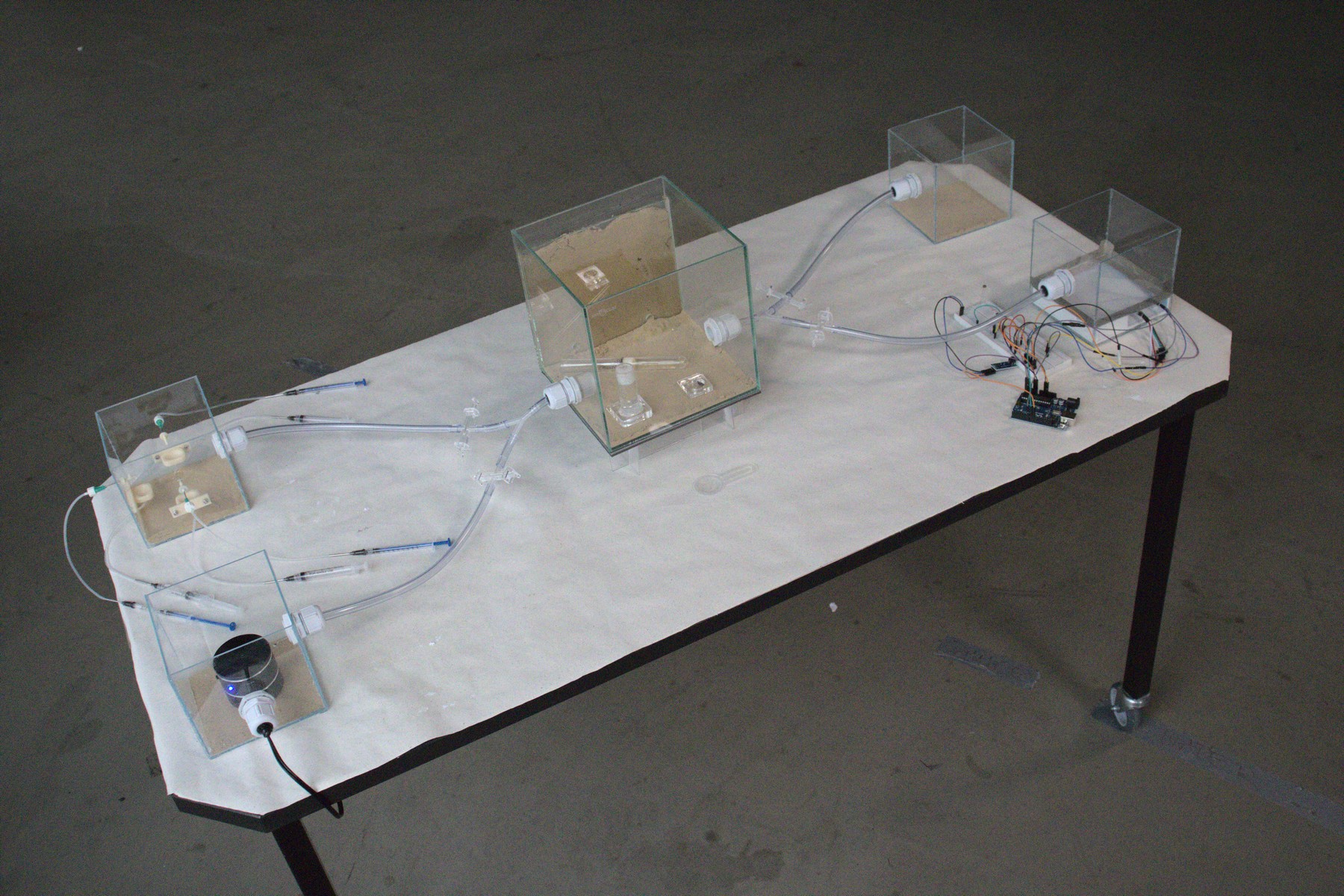
Near the end of our first semester working on the project, we focused on developing the concept of encoding/decoding into an exhibition piece. Zoo3 is a poetic reflection on interspecies domestication, founded on the idea of nested zoos: If ants are pets inside a human zoo, then humans themselves might also be pets inside someone else’s zoo. This work borrows aesthetics from zoological scientific experiments, but at its core, it is a speculative reflection. Conducting proper scientific experiments with ants needed more development time, and would later become the organising principle of Seed Potato Pixel (see ??.
Zoo3 was inspired by the Drake equation (1961), which estimates that 12,500 other intelligent life forms exist in our galaxy (Drake, 1965). A multitude of theories have been developed to explain the lack of observed extraterrestrial life in the universe. The zoo hypothesis speculates that we are being observed by extraterrestrial beings, who either are not interested in us or choose to stay hidden to observe us undisturbed. These speculations about the existence of extraterrestrial life are related to humanity’s equally fascinating efforts to communicate with extraterrestrial beings. This usually involves sending objects into outer space, most famously NASA‘s Voyager Golden Record (NASA, 1977), two identical phonograph records containing a selection of recordings which tried to portray the diversity of life and culture on Earth.
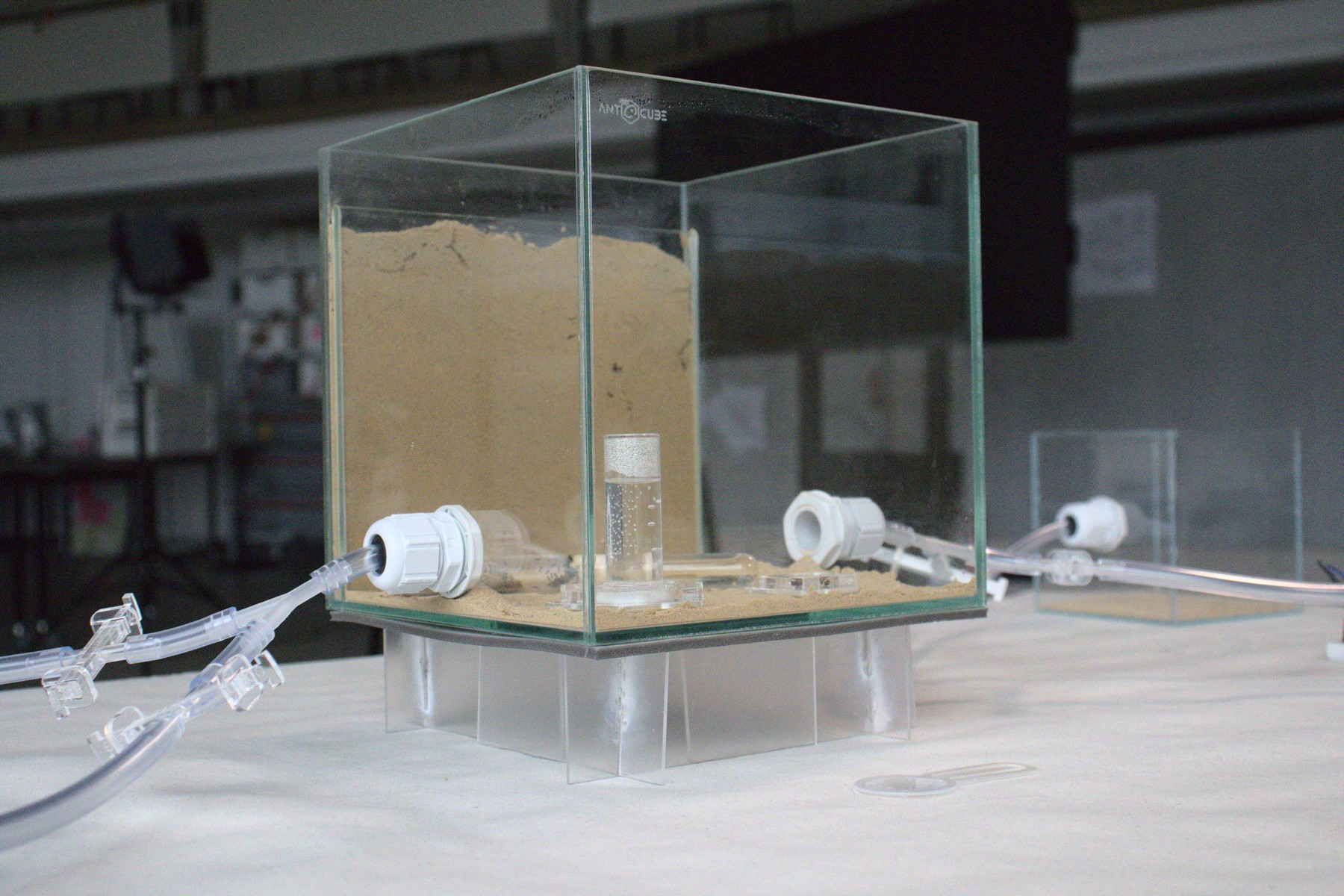
Zoo3 is made up of 4 glass chambers which are connected to the main Lasius niger nest chamber.
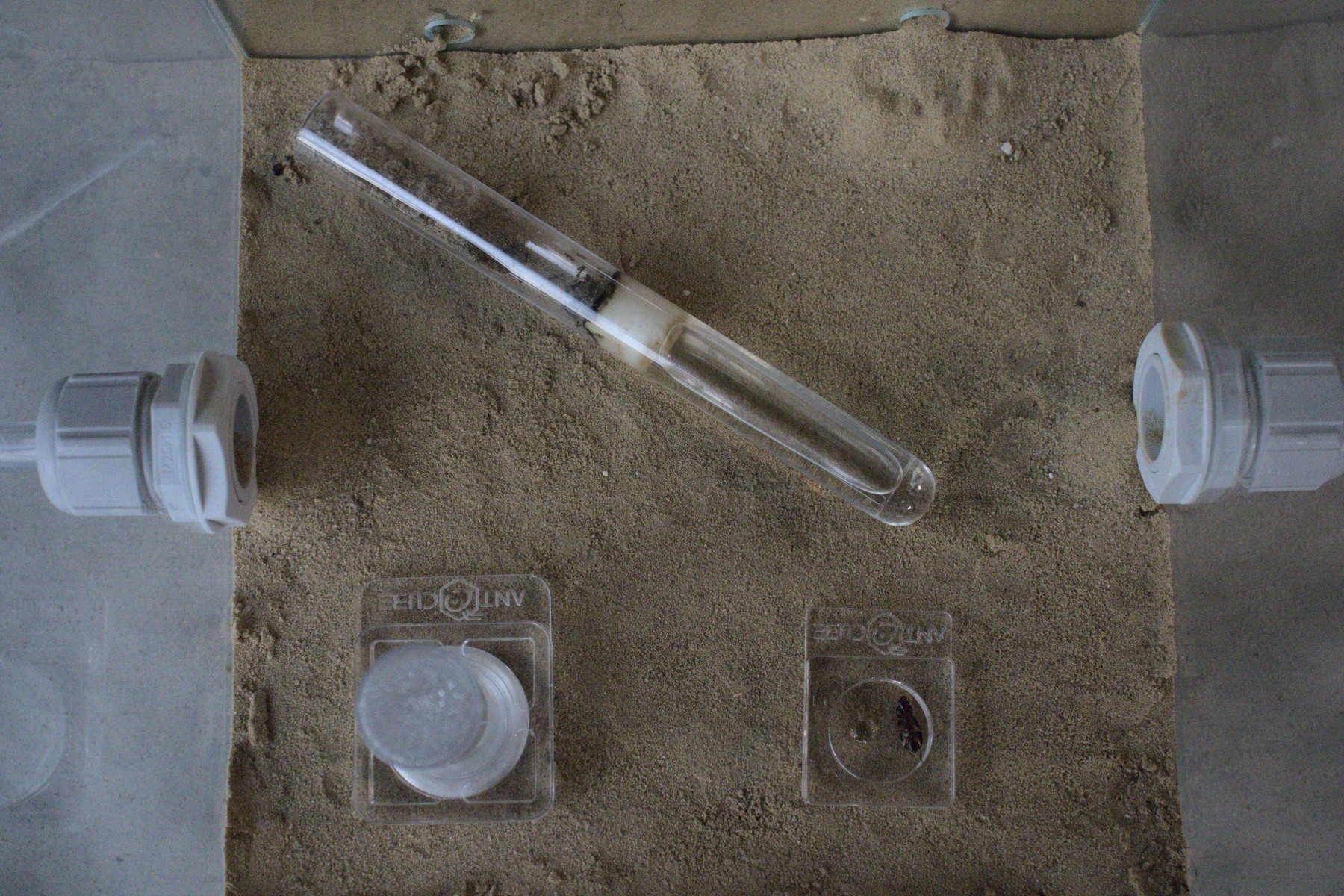
4.1.1 Chamber 0: Nest
The nest is a standard ant formicarium, filled with sand and equipped with food and water.
4.1.2 Chamber 1: Sweat fountain
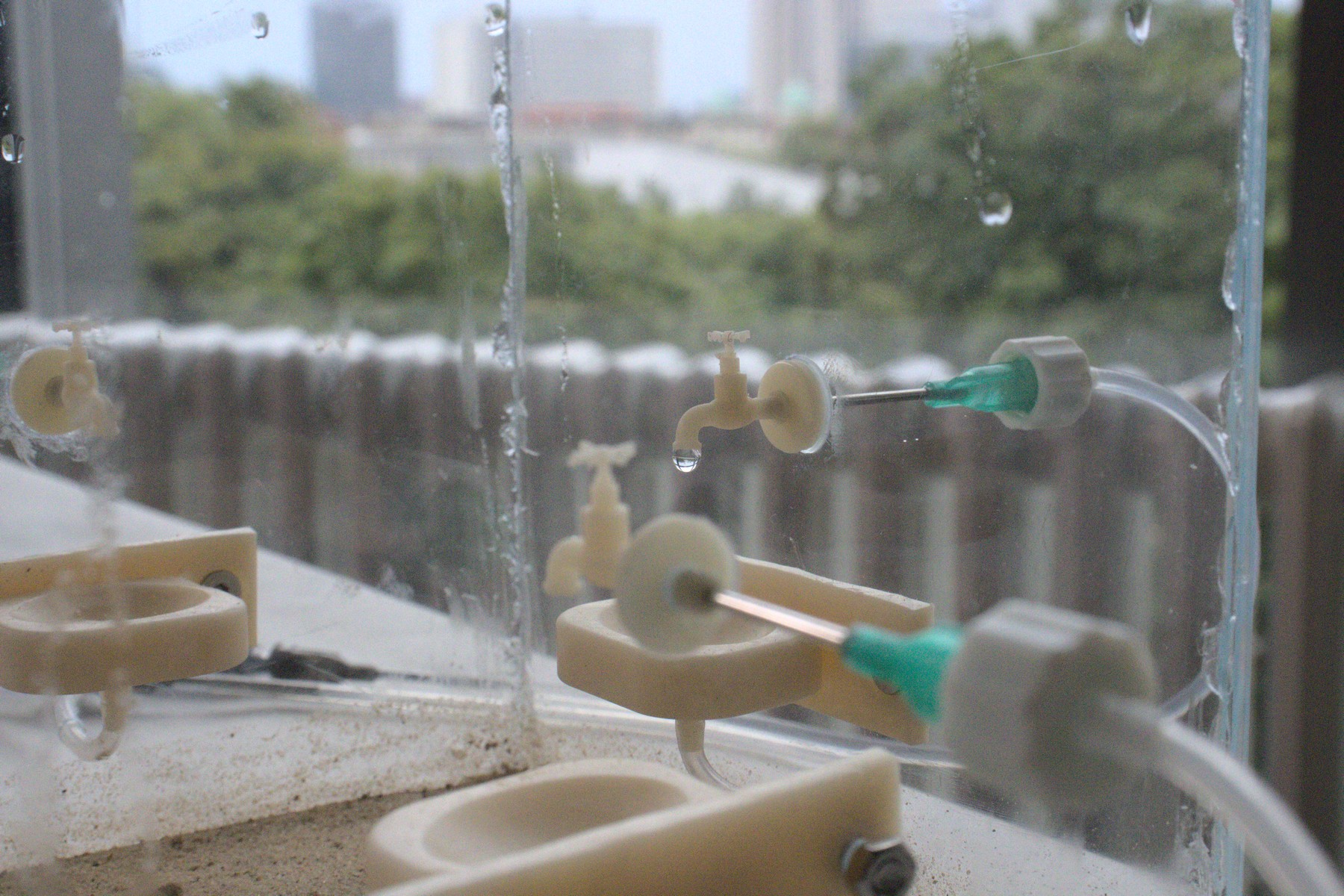
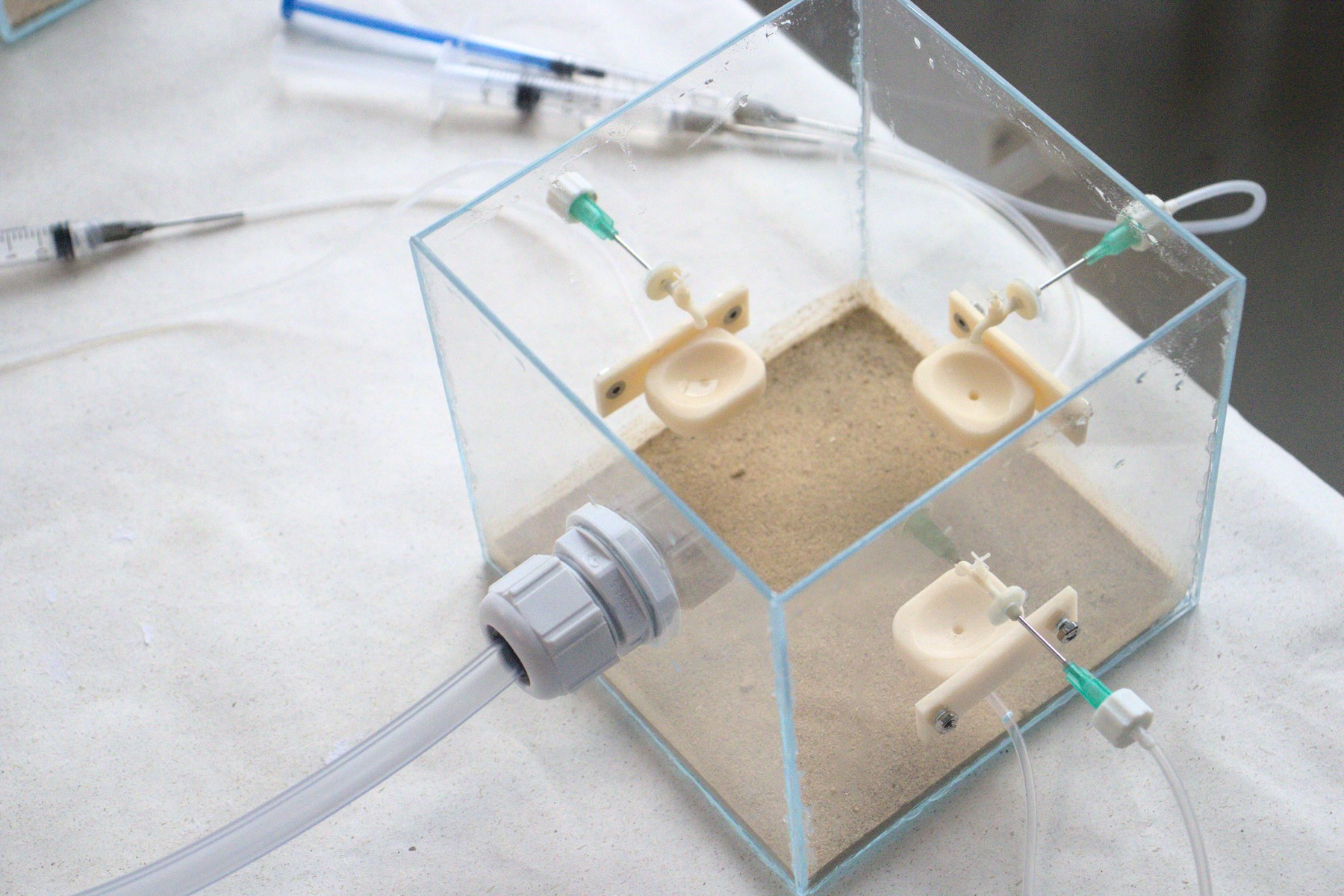
Chamber 1 has three fountains: one control fountain with water and two with sweat from different human subjects. Human visitors to the installation were invited to use a perfume on themselves, extracted from naturally deceased ants that we collected as part of our health census.
Sweat Fountain Instructions:
- To activate one of the fountains, press very gently on the blue syringe.
- To drain the tube, lightly retract the clear syringe.
Sweat collection instructions:
- Use a micro centrifuge tube
- Avoid wearing any scented products such as deodorant, perfume, lotion, or makeup to prevent contamination of the sample.
- Perform high-intensity exercise until you start to sweat
- Collect a sweat sample using the micro centrifuge tube
Ant perfume instructions:
- Spritz the perfume wherever desired and carry the pheromone trail with you throughout the day.
4.1.3 Chamber 2: Vibrations
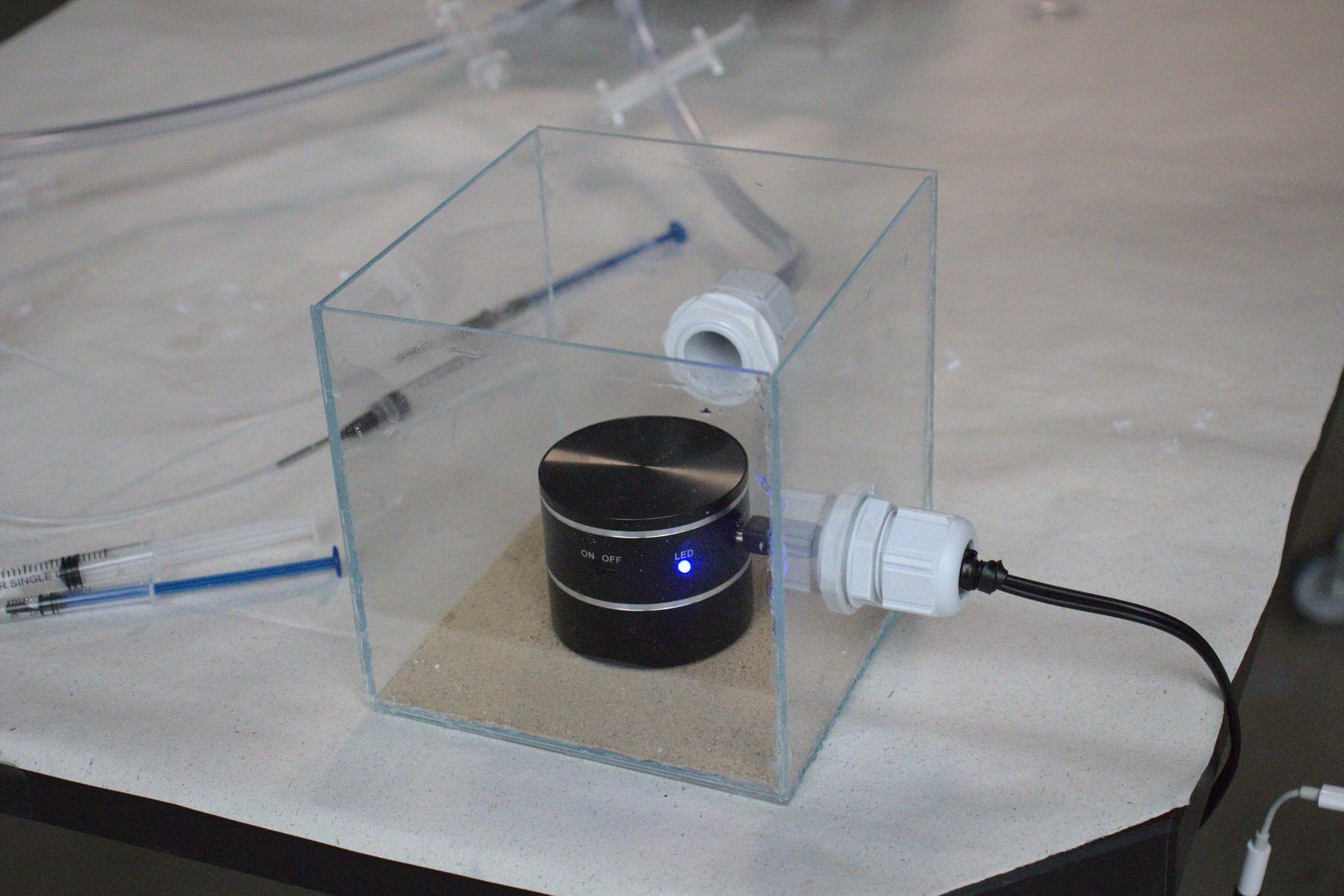
Chamber 2 includes a vibration speaker which plays frequency sweeps of a saw-tooth wave, 20- 60 Hz, lasting 6 minutes. Most species of ant can feel vibrations in the ground under their feet and use this ability to sense danger. For example, Acacia ants (Crematogaster mimosae), native to East Africa, sense the vibrations of any animal (e.g., an elephant) that starts nibbling on the ants’ Acacia tree, and respond by swarming towards the attacker (Hager & Krausa, 2019).
4.1.4 Chamber 3: Light
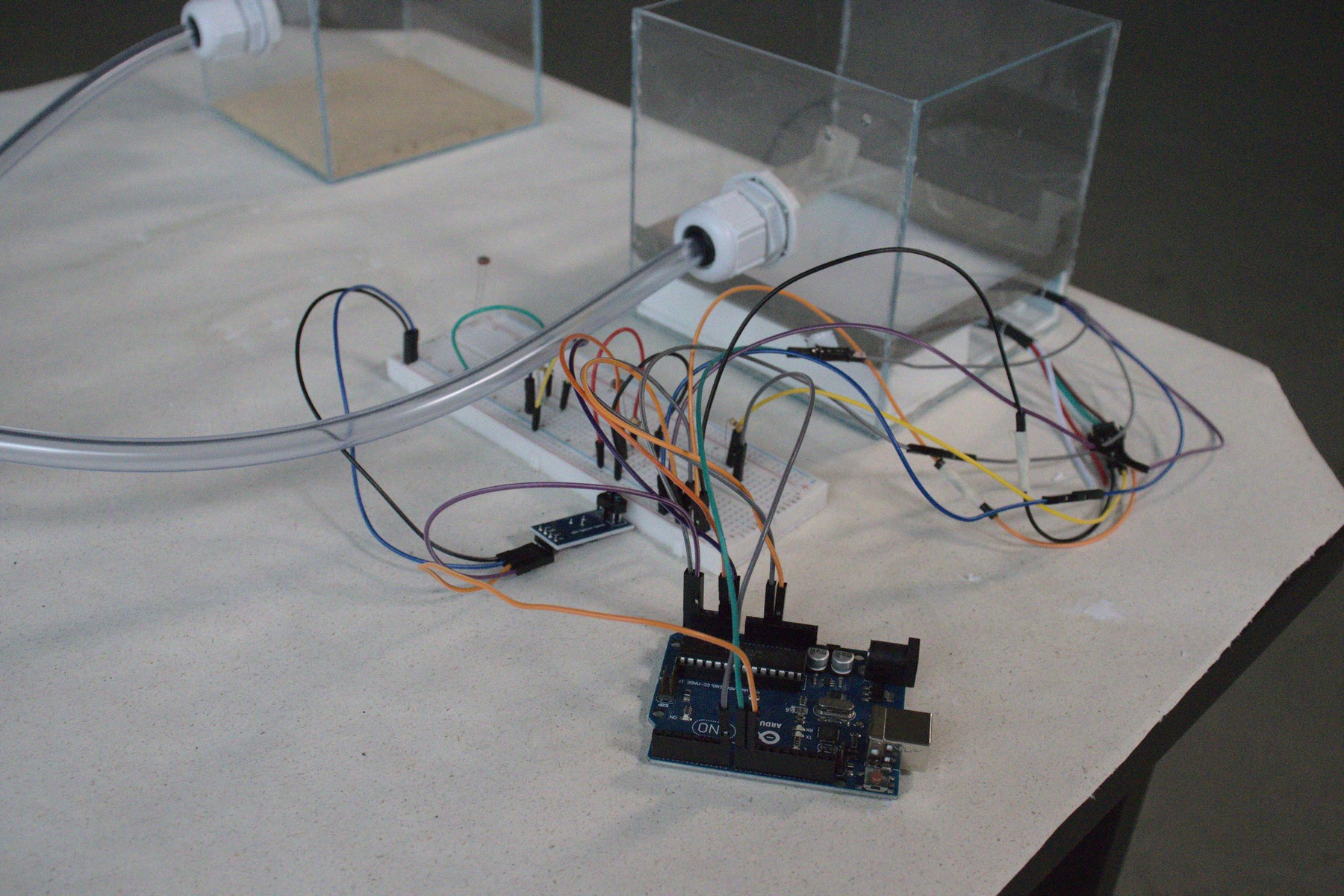
Chamber 3 includes an electronic pressure sensor which switches an LED light off/on when the ants walk on it. Sunlight is a crucial element for both ants and humans, serving as a primary light source. This chamber seeks to introduce ants to artificial lighting, powered by electricity, to observe their behavior and learning patterns. We hypothesized that the ants would be able to detect changes in their environment caused by the LED lights and learn to associate their movements with control over the light source. Whether this artificial light will provide a positive sensation to the ants remains to be determined.
4.1.5 Chamber 4: Control box
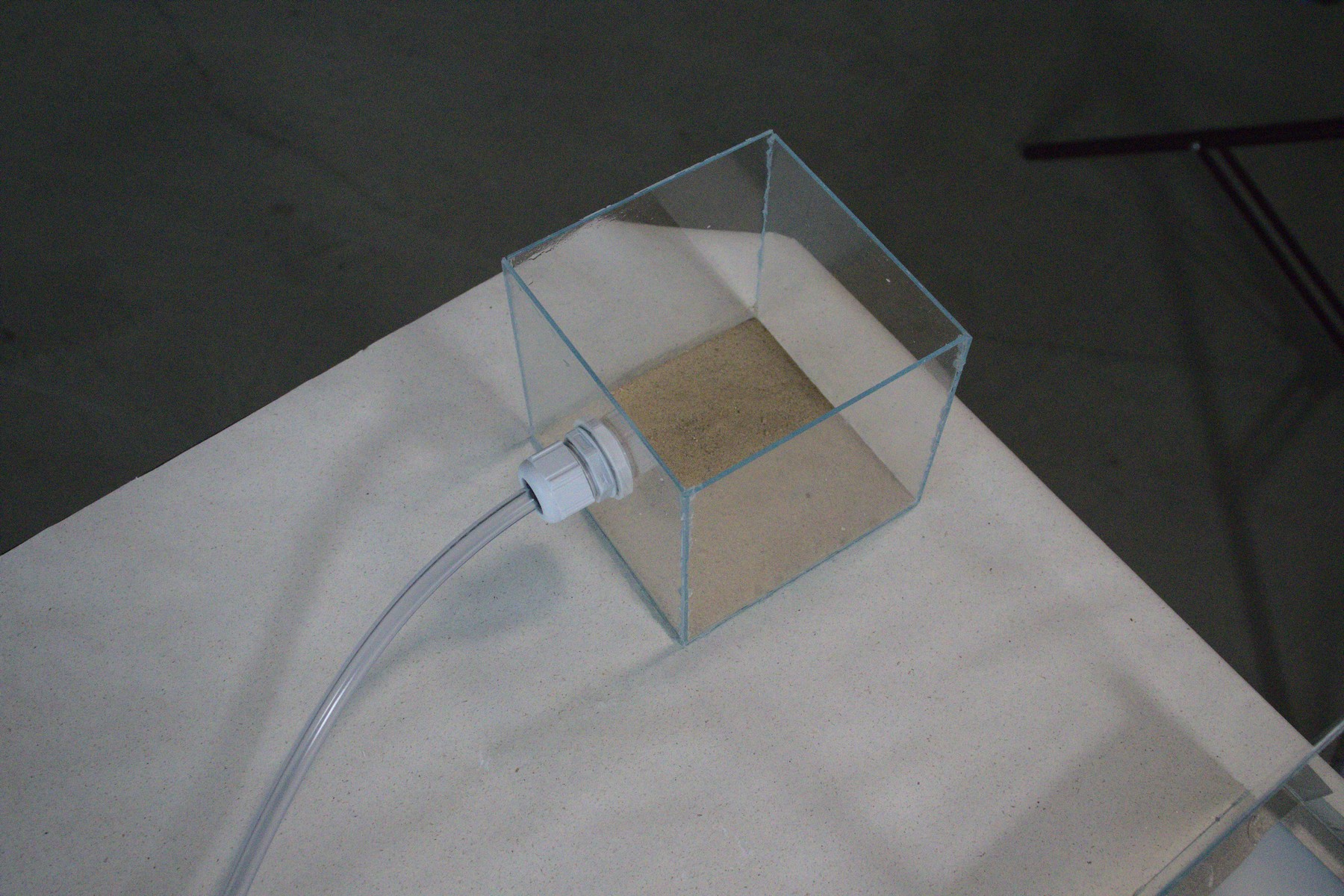
Chamber 4 is an empty box that is used as a control.
4.2 Conclusions
We did not manage to achieve our original goal of encoding and decoding ant messages. While ants do have messaging-type interactions, e.g., using pheromones, we were unable to intervene in these aspects because we did not have the required knowledge or access to technologies for sensing or artificially synthesizing pheromones. The choice to measure sweat, vibration,n and light was a good start, but each of these chambers would need fine-tuning and testing to produce meaningful results.
The encoding/decoding model of communication could be replaced by a betterfitting model. For example, Gordon says "Each encounter [between ants] is like a blank email message from an unnamed sender.”(D. M. Gordon, 2023b, p. 13). This suggests that the idea of message content could be dropped from the model, in order to focus just on making contact with the ants. While developing Zoo3, we moved from working with strongly symbolic encodings, numbers, and messages, towards materials/liquids/movements, e.g., human sweat, which do not convey a clear message, but we know will be perceived by the ants in some way. This latter approach could be described as a kind of open coding rather than encoding/decoding. Alternatively, one could argue that we dropped the idea of coding completely, and the experiment was actually about the aesthetic qualities/preferences of ants, rather than transmitting informational content.
Comparing Ants, Humans, and Algorithms
5.1 Introducing algorithms
At this point in the project, algorithms emerge as a third element alongside ants and humans. As mentioned in State of the Art, ant behaviour has been modelled using algorithms since the early 20th century rise of cybernetics, resulting in breakthroughs in the human understanding of stigmergic mechanisms and swarm intelligence. In this way, algorithmic models of ants can also be seen as new kinds of agent that share certain characteristic approaches to navigation, although on closer inspection they lack the characteristics of real living organisms. An alternative perspective is to view algorithms not as autonomous agents, but rather as interspecies interfaces or mediators. Algorithms have the ability to scale, bringing signals and images into focus, so that they can be viewed, smelled, felt, walked upon, ect. In this chapter, we work with algorithms both as agents and as interfaces. To describe how this happens, we refer again to Keeling’s concept of shared arenas of sensation, and try to extend this theory to include computational entities.
5.2 Methods
5.2.1 Method 1: Comparison
We wanted to collaborate, or even compete with ants, by creating situations where both species could affect each other. There are two potential problems with this. First is the question of whether ants have any interest or motivation to collaborate with humans. Ants already engage in various kinds of symbiotic relationships, for example with smaller insects, fungi, or trees (Ellison & Gotelli, 2021). However, these relationships are the product of long evolutionary timelines in which the organisms have gradually become entangled with one another. There is no evidence that ants would or could change their behaviours to initiate collaborations with humans, especially if the mutual benefits of the collaboration were not available immediately. Furthermore, it is hard to measure ants’ awareness of humans through bi-directional interaction. The second problem is the power imbalance which human-ant collaborations would create. Human researchers collaborate with ants as part of their professional work without being exposed to any real danger, unlike laboratory ants, which are always vulnerable and are dependent on humans for their continued existence.
Even though we still see collaboration as a key goal of the project, we opted instead for comparison. Comparison avoids the problems described above because it does not require physical interactions between humans and ants. It allows us to suggest abstract relations between humans and ants.
5.2.2 Method 2: Simulation
We used simulation to make ants, humans, and algorithms more comparable, both as a preparation for our quantitative measurements and to understand ants qualitatively through embodiment. We tried to find key similarities between ants, humans, and algorithms, so as not to get lost in the infinite number of differences between them.
Live simulation is a technique often used for understanding how it might feel to inhabit different bodies other than one’s own. On classic example of this are ageing suits, which are wearable body suits which restrict the wearer’s movement in an attempt to simulate aspects of old age, such as bad balance, stiff joints, and extra weight.
In this project, we use simulation as a method of bringing humans and algorithms a little bit closer to the ant experience. We did not focus on basic physical aspects of an ant, such as having a hard insect abdomen, feelers, and 6 legs, but rather tried to simulate more abstract characteristics, such as sensory experience, navigation, communication between individuals and a sense of being part of a wider group/collective/colony. The task of simulating ants can also be an exercise in self-reflection. The process of designing a simulation raises fundamental questions about how we think about non-humans, without leaving the practical mode. For example, while designing our live simulation, we had to find a suitably scaled version of the ant arena which would fit humans. This led to a discussion about whether to base this scaling ratio on the size of an ant vs the size of a human (estimated scale factor: 330), the walking speed of an ant vs the walking speed of a human (estimated scale factor: 171), or the walking speed of an ant vs the walking speed of a blindfolded human (estimated scale factor: 87). When attempting to make these kinds of ratio conversations between species, we always arrived at different answers, backed up by multiple equally persuasive arguments within our group.
5.2.3 Method 2.1: Human simulation of ants
We used simulation as a method for designing a live experiment for humans to experience what it is like to be ants. We wanted our participants to be physically present and work as a distributed group with a shared goal, just like ants. The resulting experiment was conducted with 24 participants in Autumn 2024, and lasted 90 minutes (30 min walk + 10 min warm up + 40 min simulation + 10 min feedback).
Starting at the main building of the TU Berlin, we walked through Tiergarten along a preplanned route. The group stopped at specific locations to listen to excerpts which we read out loud from our manifesto (see Appendix, figure 23). The walk and readings served as an introduction to the ant project and the concept of simulation, opening up space for group discussion and questions. The proximity to the Zoologischer Garten (Berlin zoo) heightened the group’s awareness of animals in the park. Participants naturally started to engage with birds and other animals along the way, priming them for the simulation.
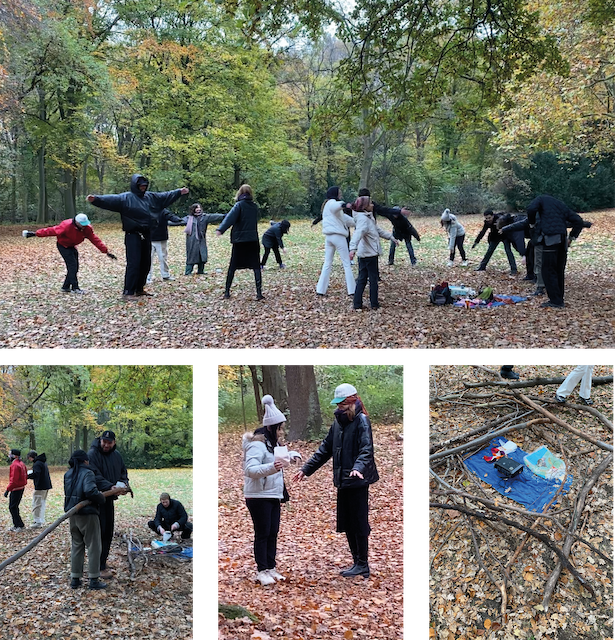
Arriving at our destination within the park, we started with a physical warm-up. This was meant to bring the participants into their bodily sensations and further strengthen the group feeling. Then we started the ant simulation, which had the following rules:
- There is a nest (a blue blanket) with a loudspeaker that plays an audio recording of underground ant nest sounds. One of us stays at the nest, distributing pheromones (wood shavings) to participants as they reach the nest.
- Each simulated ant is made up of two participants, who work together as a single organism. Their task is to search for sticks longer than a forearm and bring them to the nest, one stick at a time. Participant A is blindfolded and searches the area for sticks, simulating the physical ant. They are accompanied by Participant B (not blindfolded), who simulates the ant’s senses, warning Participant A about dangers and obstacles and giving feedback on whether a stick is reached by saying “hotter”, “colder”, or “you have found a stick!”. They are not allowed to provide specific directional advice.
- After a stick is found, Participant A returns to the nest by following the ant sounds which are playing from the nest loudspeaker. Participant B leaves a trail of pheromones (wood chips) that now indicate the shortest path from the nest to the food source.
- If Participant A stumbles upon a pheromone (wood chip) trail, then Participant B must take Participant A by the arm and guide them to the end of the pheromone trail. If there are more sticks, they bring them back to the nest, leaving a new layer of wood chips and strengthening this pheromone trail. If there are no sticks, e.g., this food source is depleted, then they can search freely again, starting from the end of the trail.
- After successfully reaching the nest with a stick, participants A and B switch roles.
Discussion Designing this live simulation, we were confronted with challenges regarding the mechanics of pheromone trails and different ways of bridging the sensory gap between humans and ants.
The sensory gap between ants and humans was most apparent regarding vision, smell, and sound. We blocked human vision to encourage ant-like, exploratory foraging behavior, which resulted in a need for more navigational support from Participant B. Since the experiment was conducted on uneven terrain with trees and bushes, we also needed to come up with a method of navigational support that would protect the blindfolded participant from tripping and bumping into something. This pair-based solution was inspired by cooperative foraging behavior, which is a real strategy used by ants (Reeves & Moreau, n.d.).
Pheromone trails fade over time unless they are regularly replenished. How could we translate this to human scale and senses, so that participants leave a temporary trail that is noticeable by other participants? Olfactory navigation in humans is primarily an implicit process (Schwarz, Yang, & Hamburger, 2024), making it unreliable for use within our simulation. After discussing various ideas like using crushed ice, paint on shoes, berries, perfume, or strings, we settled on using wood chips to simulate the navigational information provided by pheromones. Although wood chips do not disappear, they are visible on grass and biodegradable. We introduced the loudspeaker at the ant nest in order to replace the ants’ use of path-finding in order to find their way back to the nest.
Observations Overall, the simulation mechanics worked well. We were able to observe the formation of optimized pheromone trails, leading to plentiful sources of sticks. Participants reported successfully using the trails for navigation, leading to a large number of sticks as final loot. Additionally, we could observe differing foraging strategies: while some teams consistently followed trails to the same close stick sources, other teams explored very far.
We were surprised to find that a communal feeling emerged from distributing new wood chips at the nest. Participants gathered around the nest while waiting for their turn to receive them, leading to a moment of rest and information exchange. Participants were proud of the size of their collected sticks and celebrated the loot of other teams. This resulted in an increase in stick size and friendly competition over time. Teams reported enjoyment of being part of a bigger system with a clear task, since the responsibility of bringing back sticks of a certain size or number was shared among the group. The growing pile of tangible resources further increased satisfaction.
Using sound as a navigational aid for finding the nest was reported to be very helpful and to feel most ant-like. Overall, participants enjoyed the sensory setup and developed team-specific navigational and communicative approaches for solving the task over time.
Learnings Translating the temporary nature of pheromone mechanics to human scale and senses remains a challenge. Even though we did not simulate the mechanics of pheromone trails perfectly, we were able to make participants feel more like ants and work collaboratively as part of a distributed intelligence system. Participants understood the mechanics of pheromone trails better than before and reported an increase in enthusiasm and respect toward ants. The popular conceptualization of task allocation expected in ants, along the lines of “do what you are born to do, here is your task,” did not feel as dictatorial and boring as participants expected – they enjoyed this in the context of the experiment.
Overall, we managed to create a compelling bridge between the world of ants and humans and identified areas of improvement for future simulation iterations.
5.3 Method 2.2: Algorithmic simulation of ants
Ant-Colony-Optimization (ACO) is an algorithm which uses a heuristic approach to optimize existing solutions within a given solution space. A solution space refers to the set of all possible solutions to a given problem or a set of constraints. The algorithm is named after ants because of their use of stigmergy/pheromone trails, but was never intended to be an accurate model of the way ants behave. We programmed a visual implementation of ACO where digital ants could walk around and locate food sources within a pixel grid, optimizing for minimal distance to the nest.
The Capitalist Ant The Capitalist Ant was an experiment where we applied human capitalist values to simulated ant behavior. In this imagined system, we introduced the exchange of labor, goods, and nests among all ants. A model like this could help evaluate the relative value of foraging versus remaining in the nest to care for the eggs, depending on the prevailing food conditions. For example, imagine that the queen has just laid a new batch of eggs, all of which require nourishment. If the queen’s food stores are completely depleted, the demand, and thus the price, of food would rise significantly. In this capitalist ant society, the focus lies on the individual, raising the question: how much is it worth to leave the nest and risk one’s life in the dangerous act of foraging?
5.4 Method 3: Designing a formicarium for ant/human/algorithm comparison
Traditional formicariums (artificial habitats for ant colonies) typically offer a simplified, flattened representation of subterranean ant environments. These habitats, characterized by basic cubes, extruded rectangles, and silicone tubing, create clinical and sterile settings—transparent and precise yet fundamentally detached from the dark, damp, cavernous structures ants naturally inhabit. Like many animal enclosures, including zoos, these designs prioritize observation, establishing controlled experiences that separate animals from human viewers. Standard formicarium designs usually incorporate two distinct worlds: a simulation of the dark underground nest and food storage environment (inner world), and an above-ground arena for surface interactions (outer world).
The plexiglass ant cubes which we build for Zoo3, received critical feedback regarding their sterile aesthetics and conventional enclosures. This critique motivated us to reconsider our design approach, aiming for arenas that facilitate interactions while appearing less artificial.
During our iterative design process, we sought to move beyond restrictive conventions toward environments that are engaging to both ants and humans. Sandcastles emerged frequently in discussions as metaphors for playful exploration and material experimentation. The whimsical notion of constructing scaled-down miniatures of human architecture prompted us to explore whether such structures could influence ant preferences.
We developed an interactive sandbox prototype (2 x 1.6 meters, containing 200 kg of Sahara desert sand) to facilitate human-ant interactions through playful exploration. Participants constructed various sand forms—walls, bridges, pyramids, and castles—to creatively engage with ant habitats and consider the impact of human structures on ants. Although this setup enabled observation and testing of human behavior and spatial dynamics, practical issues emerged, notably participants’ reluctance to step into the sand for fear of harming ants or social discomfort.
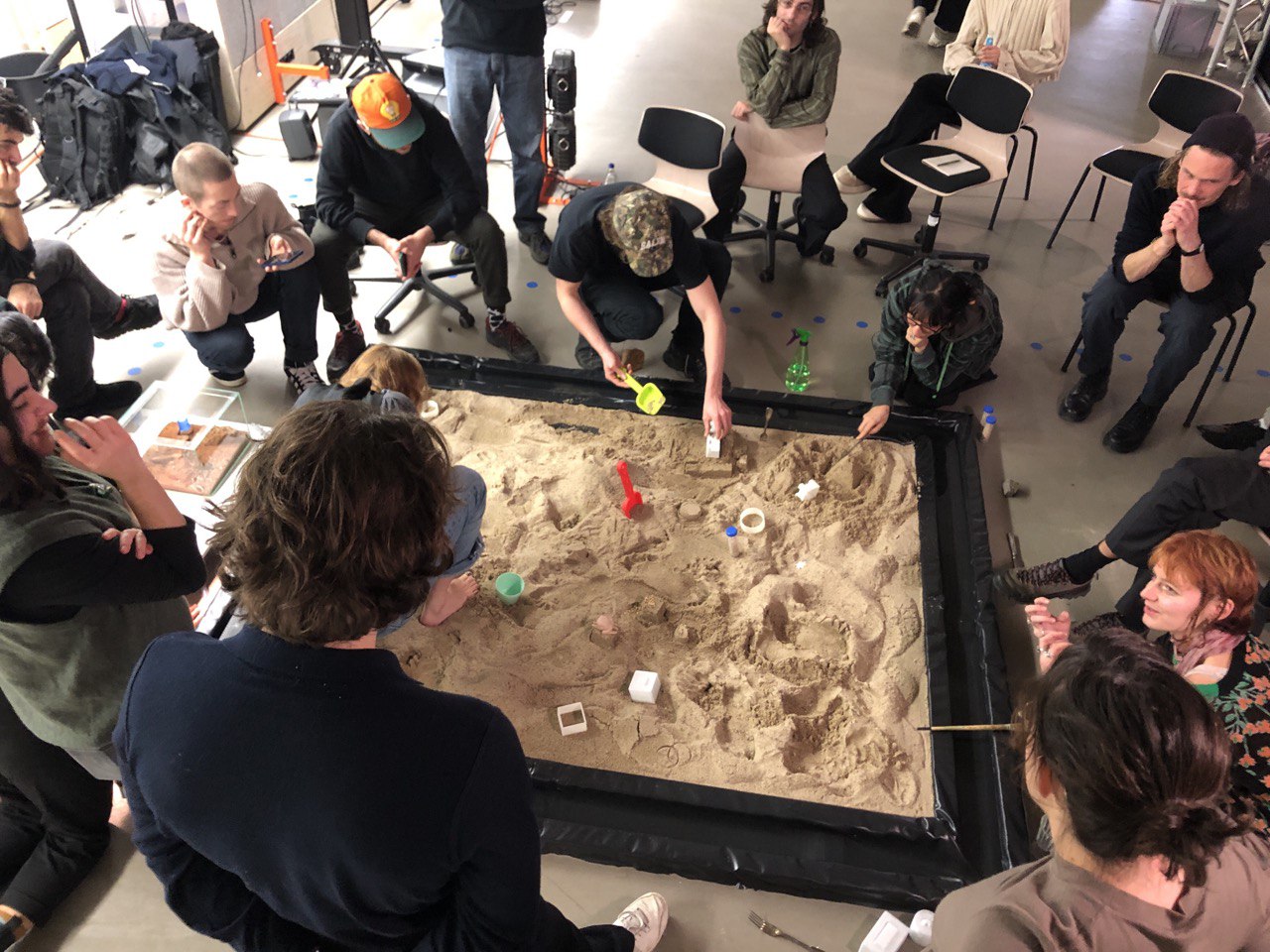
We then pivoted our research towards real-life ant architecture and structures, and the scientific practice of excavating ant structures through casting, which involves the pouring of molten metal, plaster, or concrete into abandoned or perished supercolony nests in order to get a positive representation. We encountered a study that analyzed nest architecture across ant species, highlighting how foraging behavior influences structural characteristics (O’Fallon, Drager, Zhao, Suarez, & Pinter-Wollman, 2023). This study included a comprehensive digital archive of nests through 3D scanning. We reached out to Professor Noa Pinter-Wollman from the Department of Ecology and Evolutionary Biology at UCLA, who generously provided us access to their complete 3D scanning archive. Utilizing these scans, we proposed scaling them up and employing 3D printing technology to create formicariums that accurately reflect ant nest architectures. This would have provided both visually instructive models for human observers and more naturalistic habitats for ants. However, this proposal was put on hold due to feasibility concerns and time constraints.
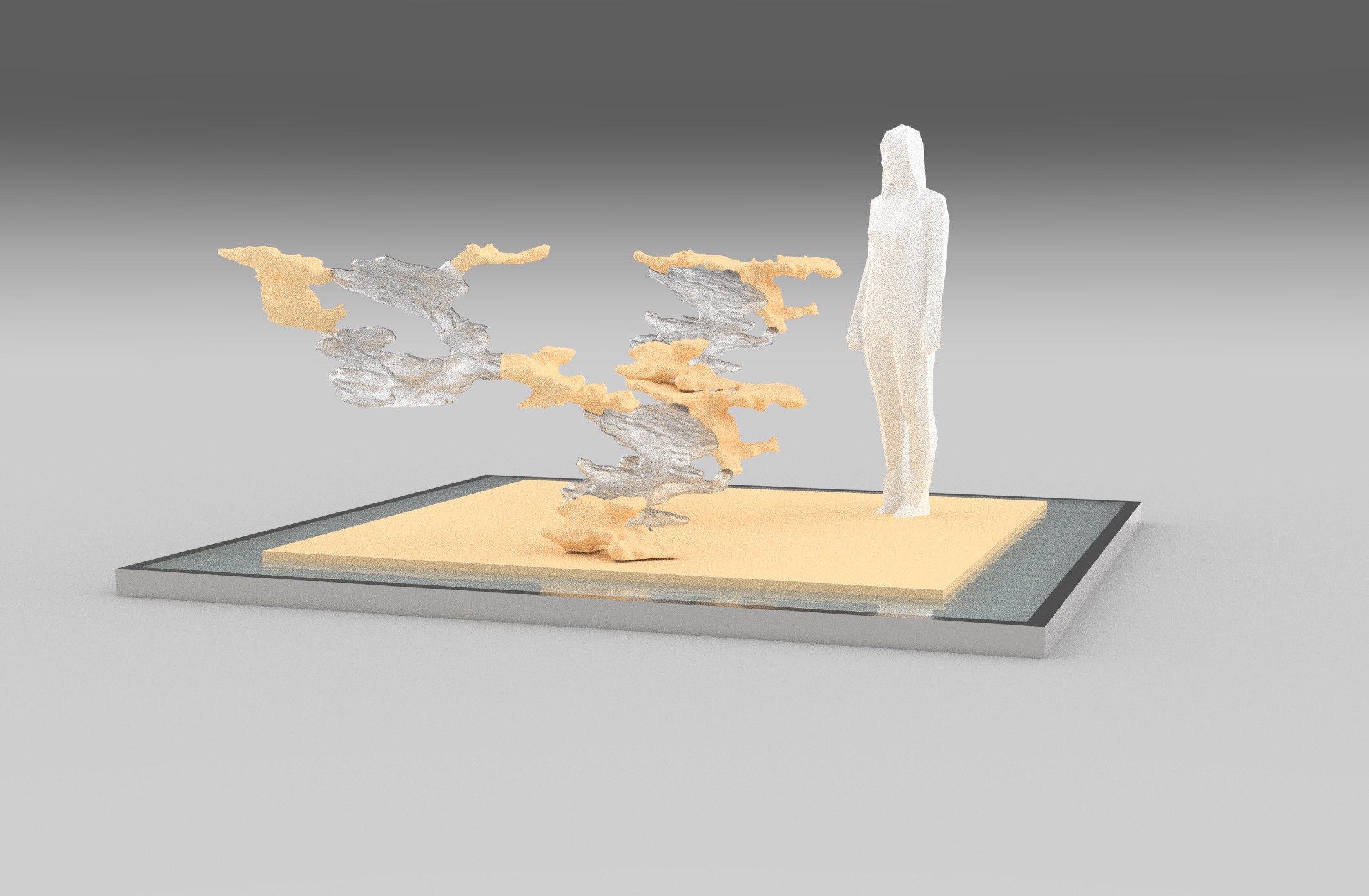
Ultimately, after sketching multiple designs, we chose to adapt our 2m x 2.6m interactive sandbox design, which used a water-filled moat to contain the ants. While retaining the fundamental structure, we replaced the ineffective moat with secure plexiglass barriers. The "arena" transitioned from direct ant-human interaction to a digitallymediated environment, which integrated ant-tracking technologies and projection mapping (see Computer Vision Tracking). This innovation combined physical space with multidimensional digital simulations projected onto a single interactive sandy surface.
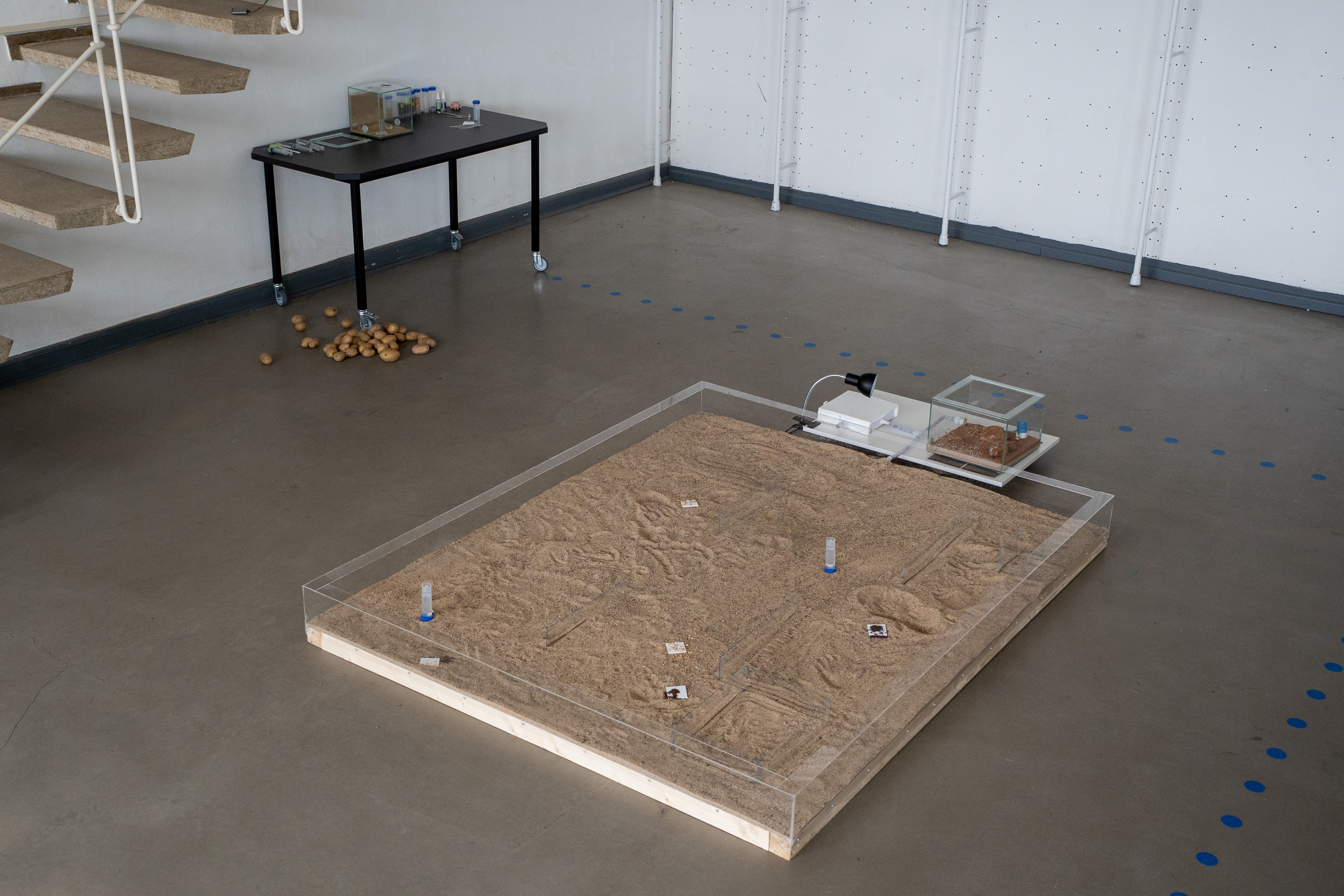
5.5 Method 4: Tracking ants
We chose to focus on tracking walking paths, because they are one of the most easily recognizable aspects of ant behavior. This resulted in a number of experiments which are described below.
Taking an ant for a walk The first tracking method that we used involved using a graphite pencil to trace a line directly behind one ant as it moved across the concrete floor of our studio (figure 13). Already with this low-tech method, it is possible to see the different trajectories that the ant explores, drop-off locations, and the ant following its own pheromone paths. Walking on the concrete floor of the studio, the ant is constantly disturbed by people, as well as the pencil and human drawer who follow the ant from a distance of 10 centimeters. We expected that the ant would start to explore the entire studio ( 400 square meters), but in the 20 minutes that we recorded, it explored an area spanning only 150 centimeters, walking a total of around 4.5 meters.
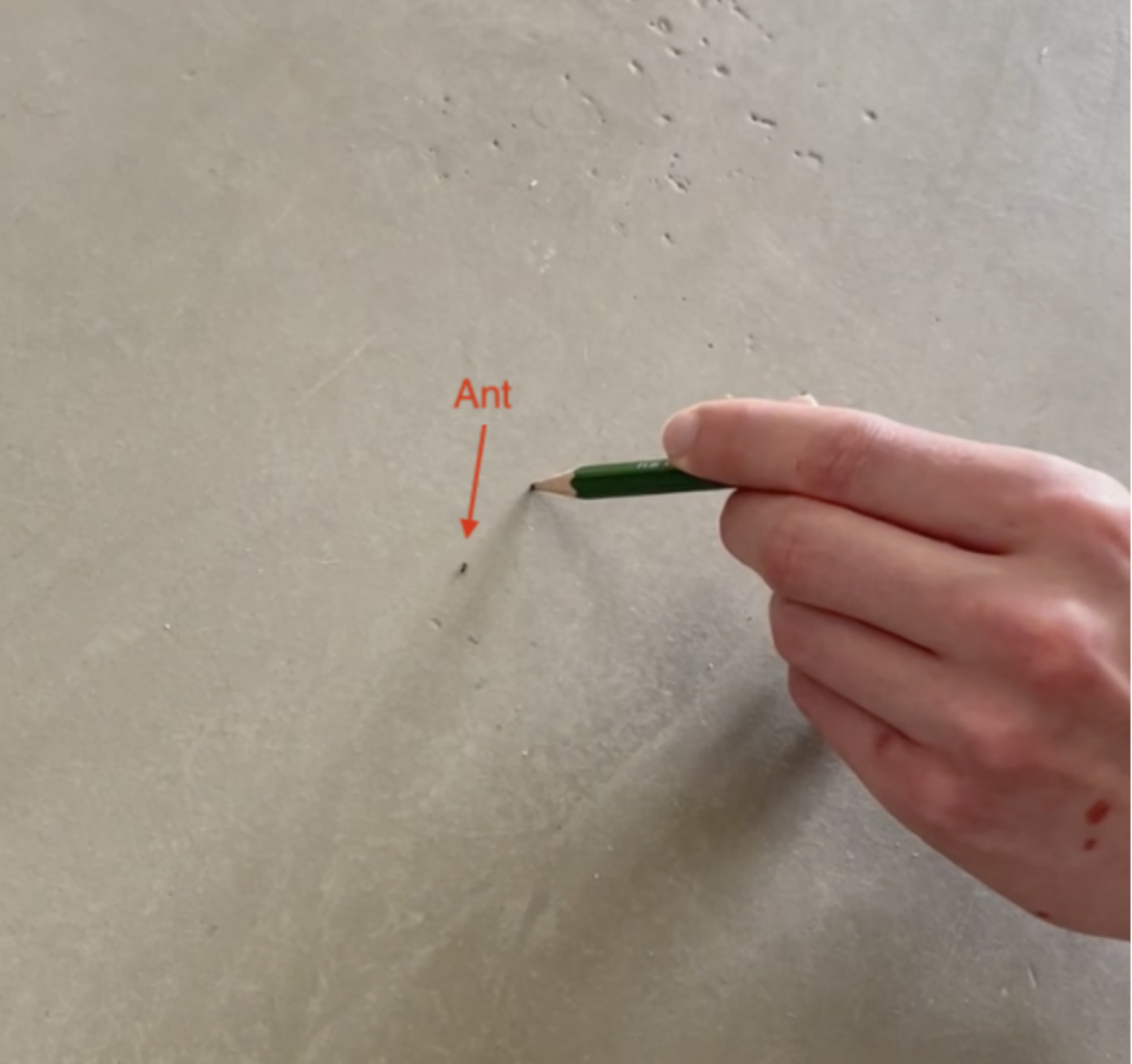
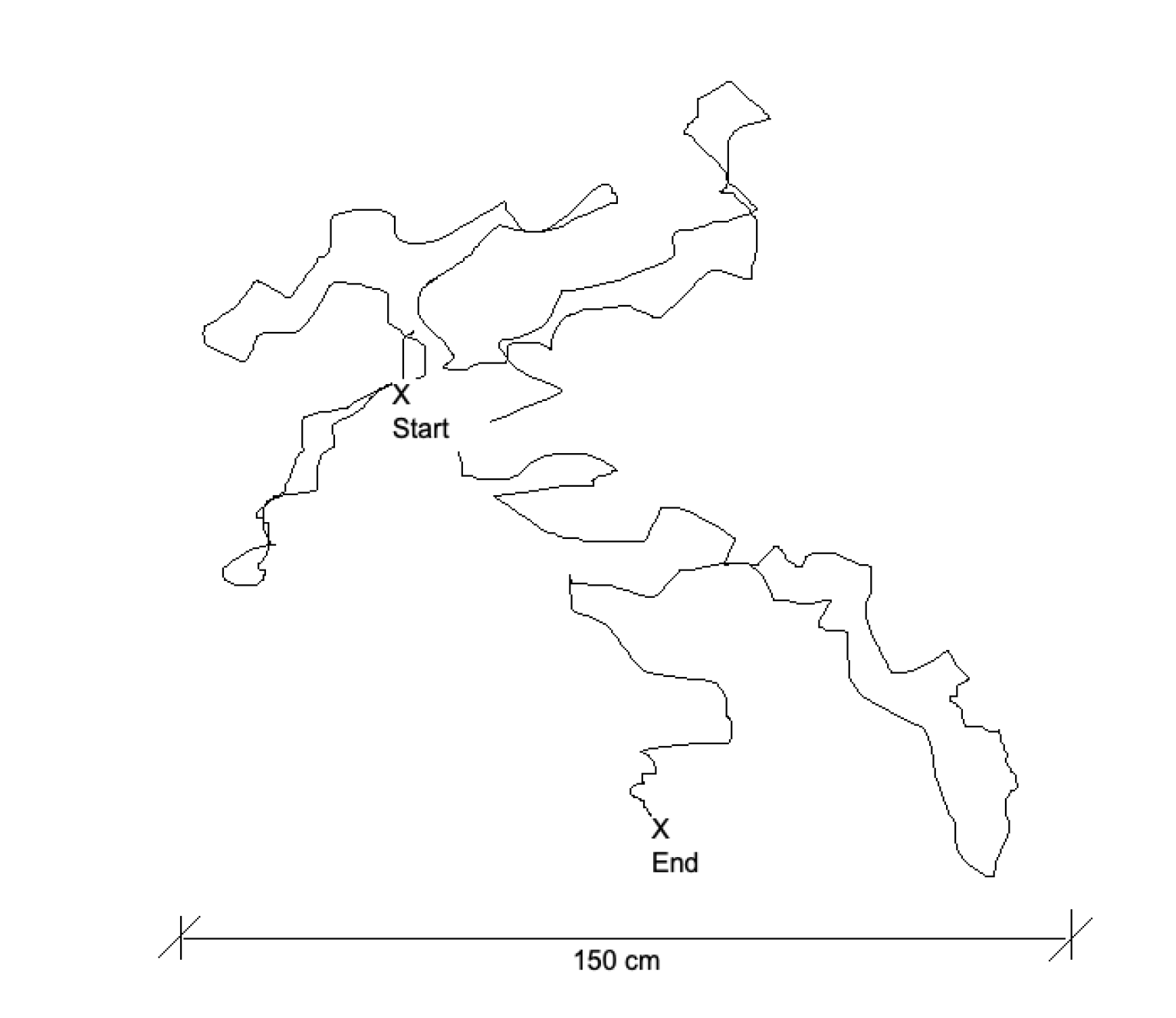
Elevated drawing comparison The second tracking experiment was a direct comparison between human and ant paths. To do this, we installed a participatory drawing station on the balcony, giving participants a top-down overview of the entire studio. The drawing station included paper, pens, and the ants in a glass formicarium on the table. During Lange Nacht der Wissenschaft 2024, members of the public were invited to sit down and draw the walking paths of humans down below. The layout of the studio was set up for an exhibition, with members of the public walking through, stopping to talk or look at artworks, or going to the bar to get a drink. Afterwards, the participants repeated the exercise by drawing the walking paths of ants inside the formicarium in front of them. The ants stopped moving and went to sleep sometime during the experiment, while the humans continued walking. The exercise was not only an experiment in comparing walking paths, but also looked at different ways of bringing humans into contact with ants, and framing a comparison between humans and ants. 8 exhibition visitors engaged further by writing comments, observations, and questions next to their drawings.
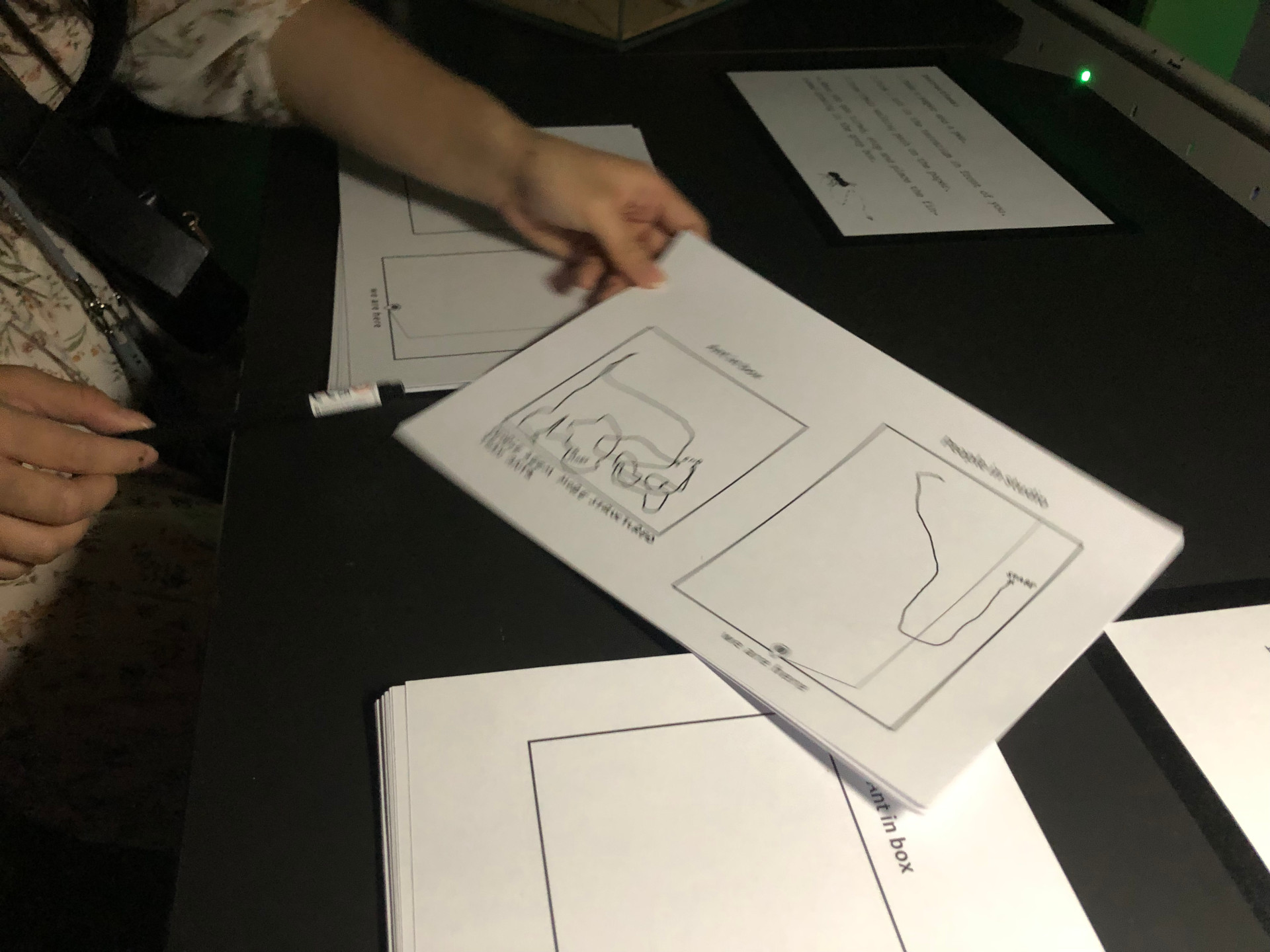
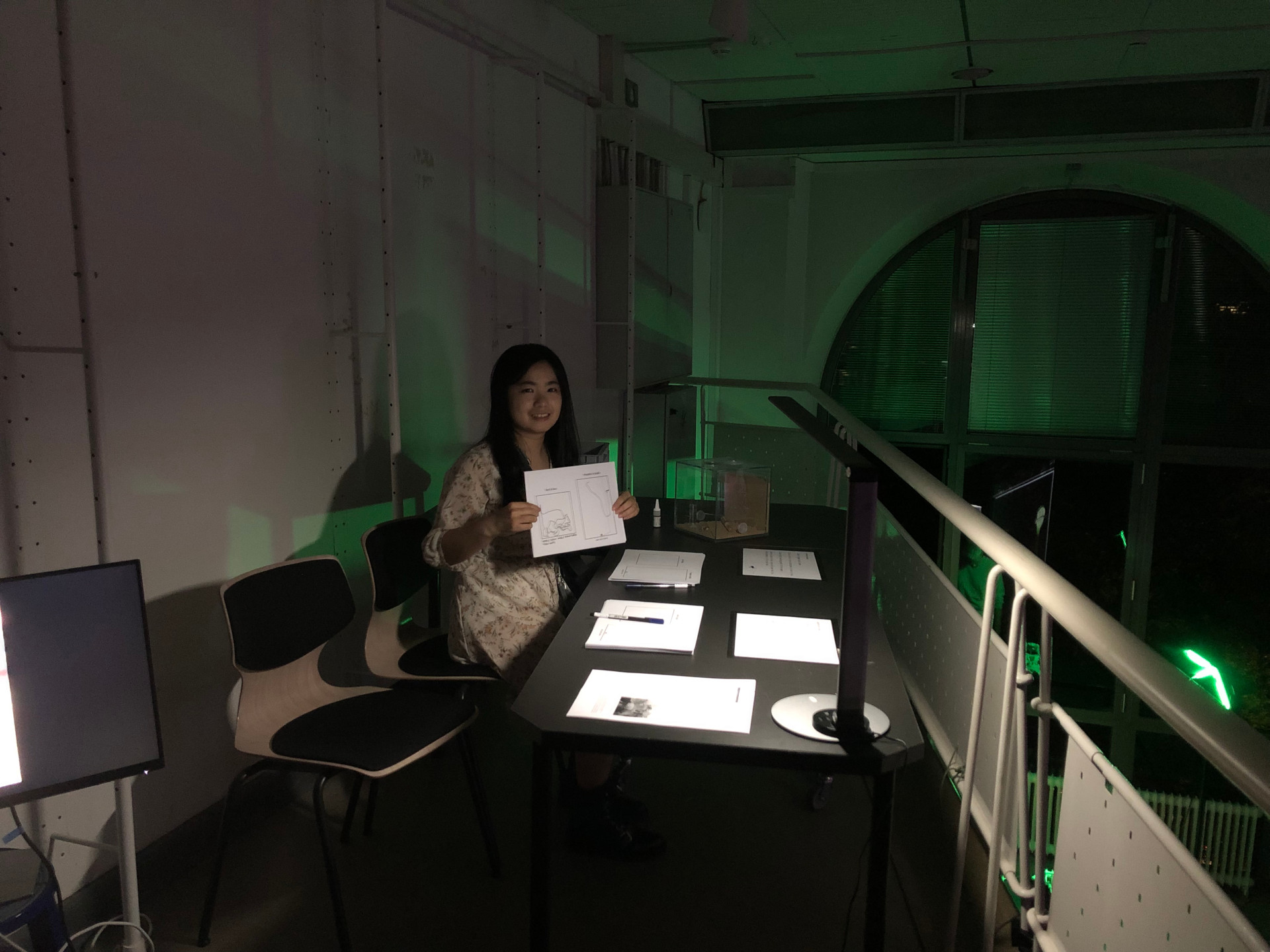
Walking, searching for ant nests The third tracking experiment was an attempt to map locations of ant nests on the TU Berlin campus. This was conducted by going outside, finding individual ants, and following them back to their nests. We identified two ant nests, one with two entrances, and the other with three entrances, in the garden near to our studio. We imagined using this data further in an XR mixed Reality interface, where archival information of ant colony locations, bio data, and stories would make the ants visible as one walked around the city. This idea was abandoned as the cold Berlin winter set in and the urbanised ants went into hibernation.
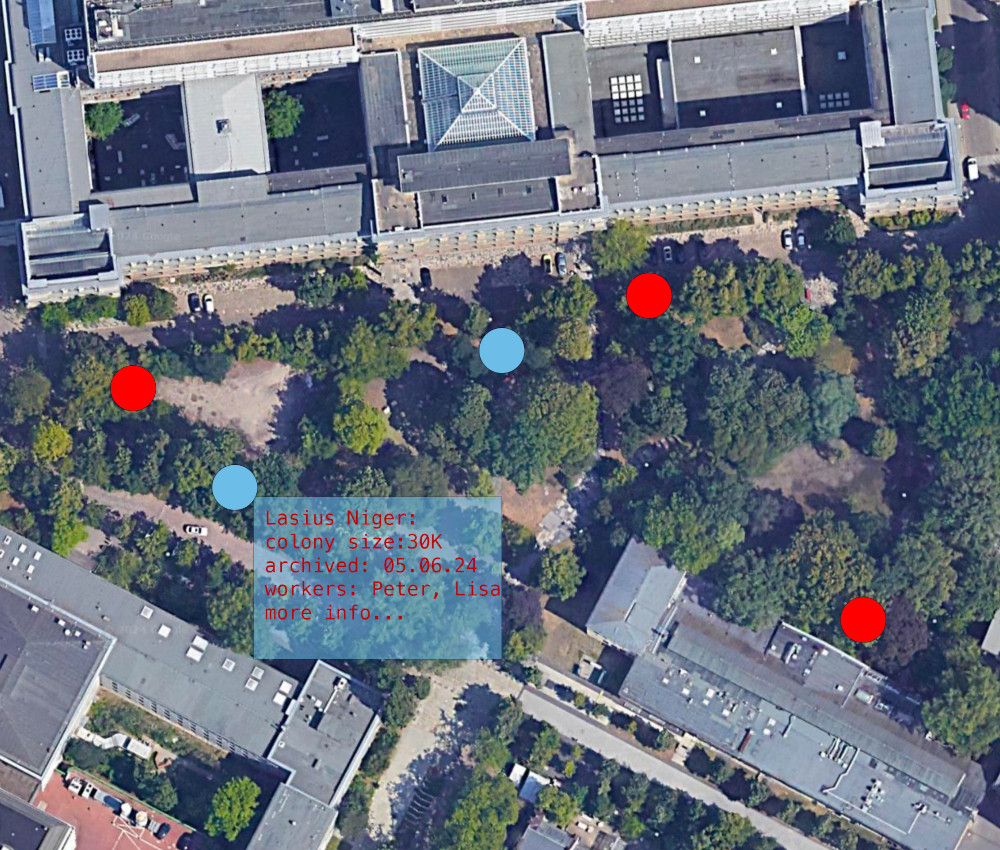
Computer Vision Tracking After building our 1.6m x 2m sandbox (see Method 3: Designing a formicarium for ant/human/algorithm comparison) and connecting it to the ant nest via a tube, a large number of ants started to explore the sandbox. It was difficult to keep track of these ants, since they were hard to find and follow with the naked eye. In response to this problem, we developed a live computer-vision tracking algorithm, combined with visual projection, to draw ant walking paths onto our formicarium sandbox in real time.
Tracking ants with a webcam (Dell UltraSharp Webcam 4K) inside the studio environment poses several technical challenges. The ants were registered at a size of only 1-10 pixels, making them difficult to track. The lighting conditions in the studio changed during the day, with extra shadows and movement from students as they moved around the sandbox. The program is written in Python and uses the OpenCV computer vision framework. It functions as follows:
- The webcam takes one image per second.
- The background is subtracted by comparing the current frame to the previous one.
- Noise is removed from the image.
- Candidate ants are detected if they are between 1 and 10 pixels.
- If a candidate ant exists for more than 3 frames, then it is considered a real ant.
- Ants which are inactive for 5 seconds or move more than 10 pixels in a single frame are removed.
- The walking paths are always projected onto the sandbox and update every 5 seconds
The resulting algorithm is available in our Git repository ((InterspeciesResearchCluster, 2025)).
5.6 Method 5: Measuring ant activity and colony health
Keeping track of our colonies’ activity and health was a primary concern. Despite establishing a routine for feeding, changing water, and observing behavior, we were lacking possibilities for monitoring ant activity and colony health.
We started keeping track of our Messor aegyptiacus colony’s death rate by counting the number of dead ants in our formicarium every seven days. Limitations of this method include: the potential human counting errors and data pollution; it requires a lot of time; and not knowing the population size and birth rate. There are several other scientific methods for tracking the health of ant colonies, such as MRR, excavation, and infrared sensors (see Measuring activity in ant colonies). We chose our method because of our interest in combining caretaking with the data-gathering process.
After finishing the project, we repurposed our computer-vision tracking system in order to generate data about colony activity in the sandbox for the purposes of health monitoring.
Seed. Potato. Pixel. (2025)
Methods 1-4 were used to conduct three experiments, which later came together in the exhibition piece Seed. Potato. Pixel. Each experiment investigates a different heuristic approach to collective foraging behavior: Seed explores the navigational strategies of ants; Potato translates ant foraging to human scale and sensory experiences; Pixel translates ant foraging algorithmically with digital agents. These three layers are brought together in the final exhibition piece to create a visual interplay between humans, non-humans, and algorithms.
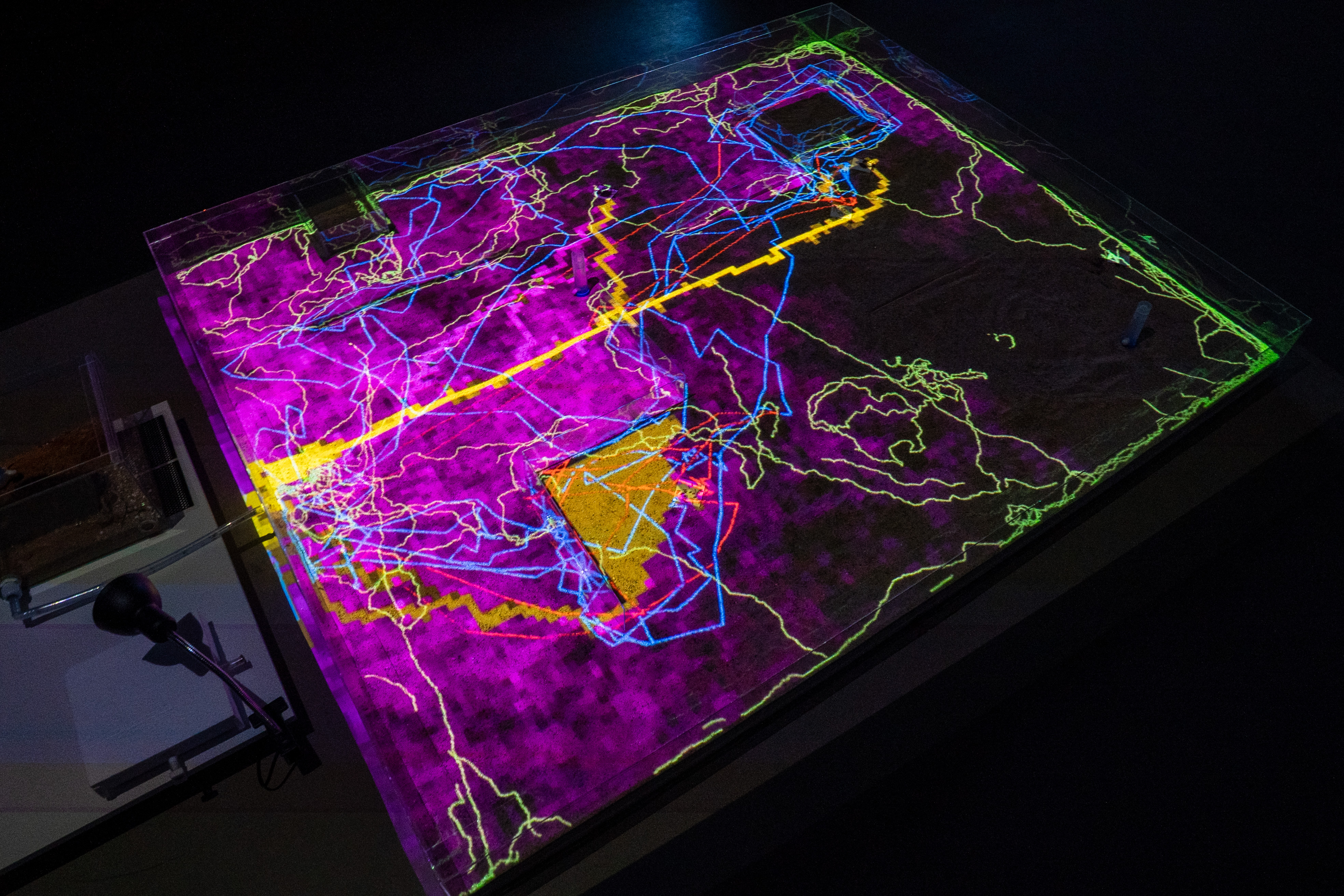
6.1 Aims
6.1.1 Aim 1: Utilising technology as interspecies interface
This aim is the same as the one mentioned in Introduction: Aims of the project. We want to use technology to bring ant, human, and algorithmic worlds onto the same scale, both as a research strategy and a way of communicating the observations and findings of our experiments. This includes spatial scaling and temporal scaling.
6.1.2 Aim 2: Comparing patterns and strategies of spatial exploration in foraging
We want to make the ants’ walking paths visible to a human audience by adopting presentation methods from contemporary art. In doing so, the spatial exploration patterns of each type of agent should become observable and comparable.
Inferring the meaning of observed patterns, we strive to uncover spatial exploration strategies (e.g., orientation using walls). This includes the prioritization of different sites and resources (e.g. smaller closer food sources vs more distant larger food sources); to what extend our ants are using pheromones; how humans perceive space differently during an ant simulation; and if something that looks like intuition or cognition similar to biological agents emerges in artificial agents.
6.1.3 Aim 3: Bringing algorithmic models of animals into conversation with the human model makers and the animals themselves
We aim to bring algorithmic models of animals into dynamic interaction with the animals they represent and their human creators, exploring how metaphor functions not as a one-way representation but rather as a mutual, transformative process of domestication. This includes practically investigating how these reciprocal metaphorical exchanges, enacted through simulations and playful engagement, shape behaviors, perceptions, and empathetic understandings across species boundaries. We also aim to critically examine the rhetoric of analogy and naming, questioning what it means, ethically and epistemically, to say one organism is “modelled after” another.
6.2 Experiment design
6.2.1 Experiment 1: Seed
In this experiment, we created a labyrinth in our 2m x 1.6m sandbox, using five plexiglass walls. We added piles of food (seeds) at specific locations within the labyrinth. For three days, we tracked the movement of all ants entering the labyrinth with our computer vision tracking (see Method 4: Tracking ants).
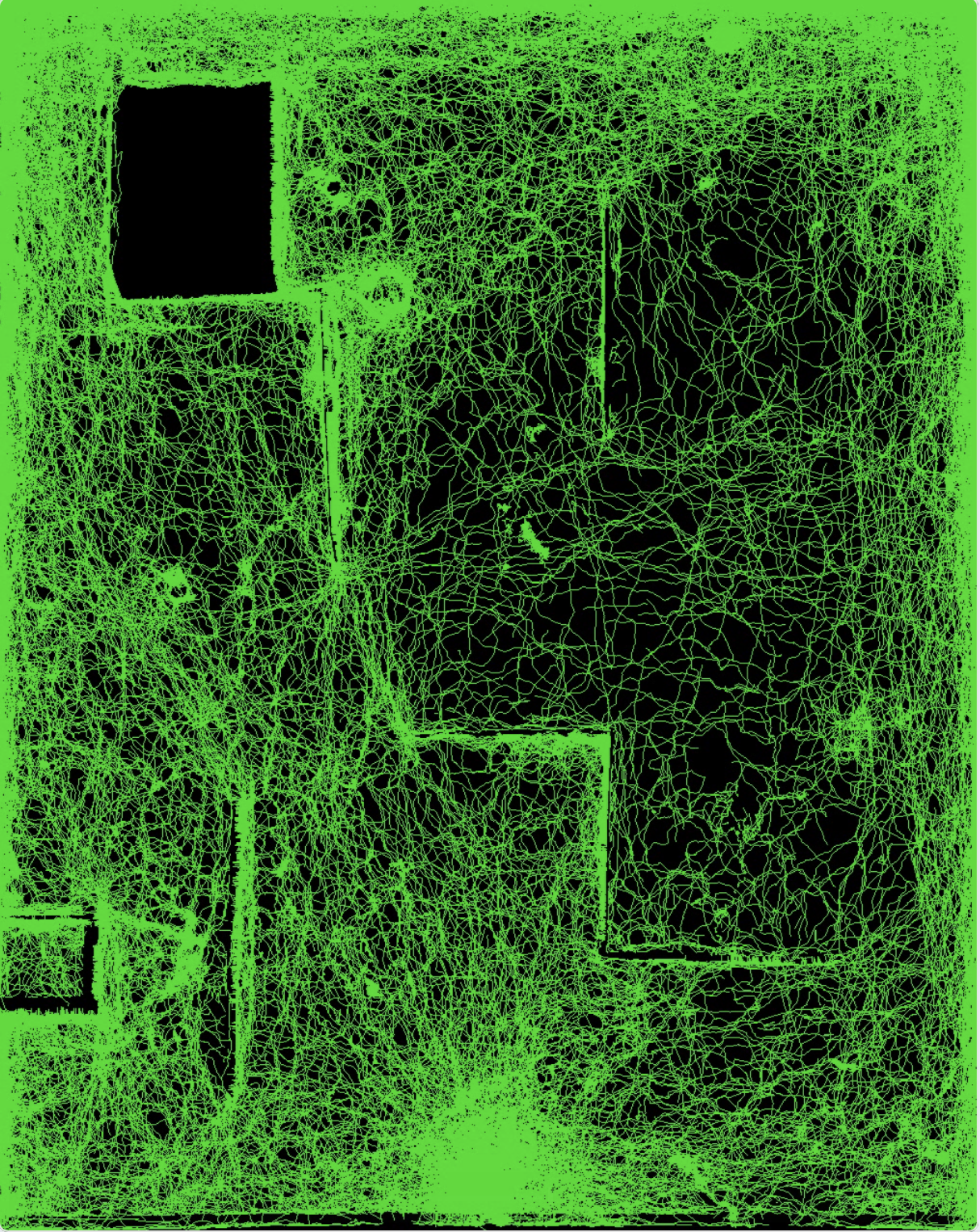
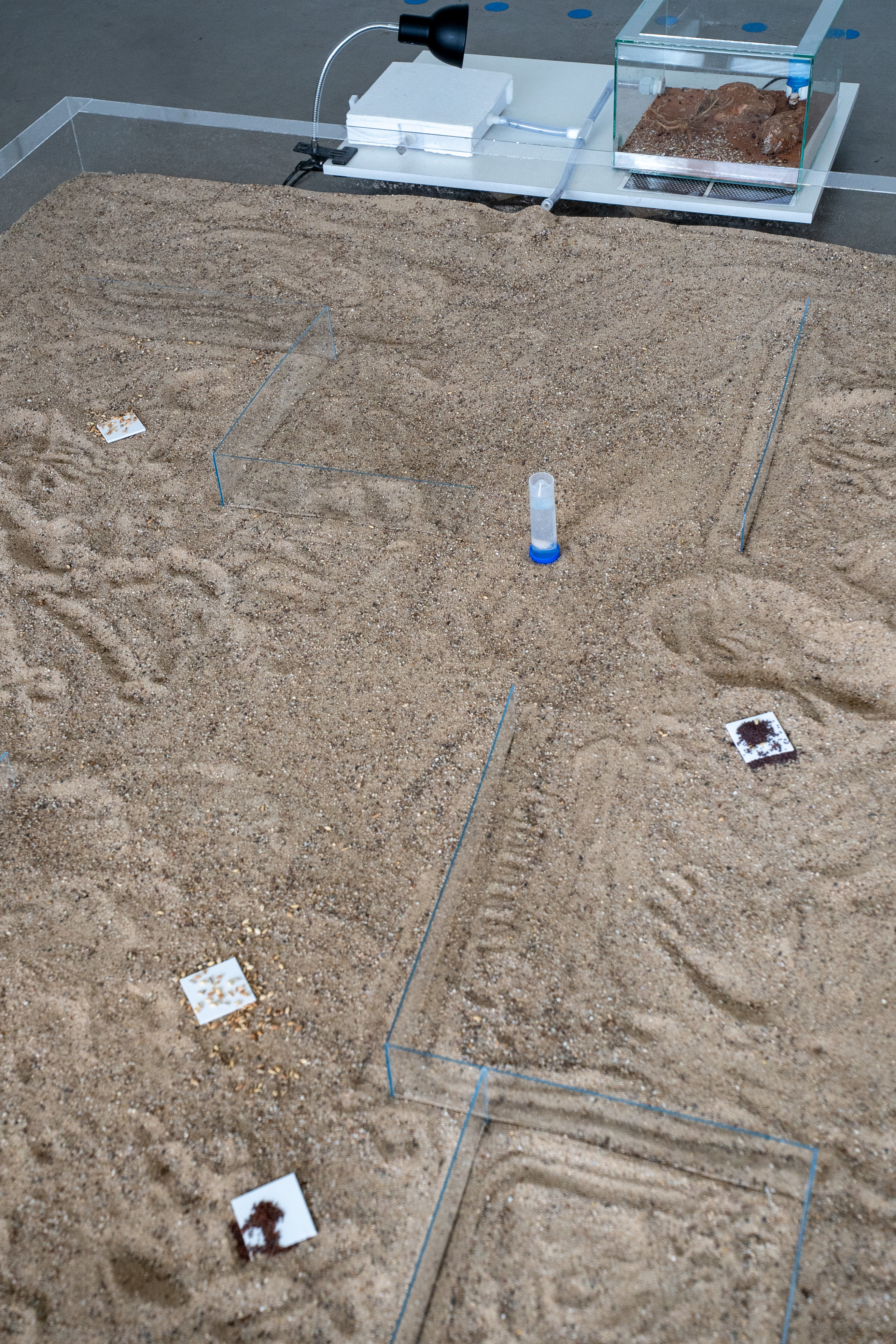
6.2.2 Experiment 2: Potato
In this experiment, we translated the ant sandbox labyrinth to human scale, in the 20m x 16m (scaling factor=10) indoor Lichthof in the TU Berlin main building. We then placed food and obstacles at identical positions to Experiment 1. For food, we used potatoes rather than seeds. For obstacles, we used ropes tied between chairs rather than plexiglass walls. Four participants were tasked with finding as many potatoes as possible in a 30-minute time frame. Paralleling Experiment 1, we tracked the human movements with a camera from above to create a dataset of human walking paths (see Figure 22).
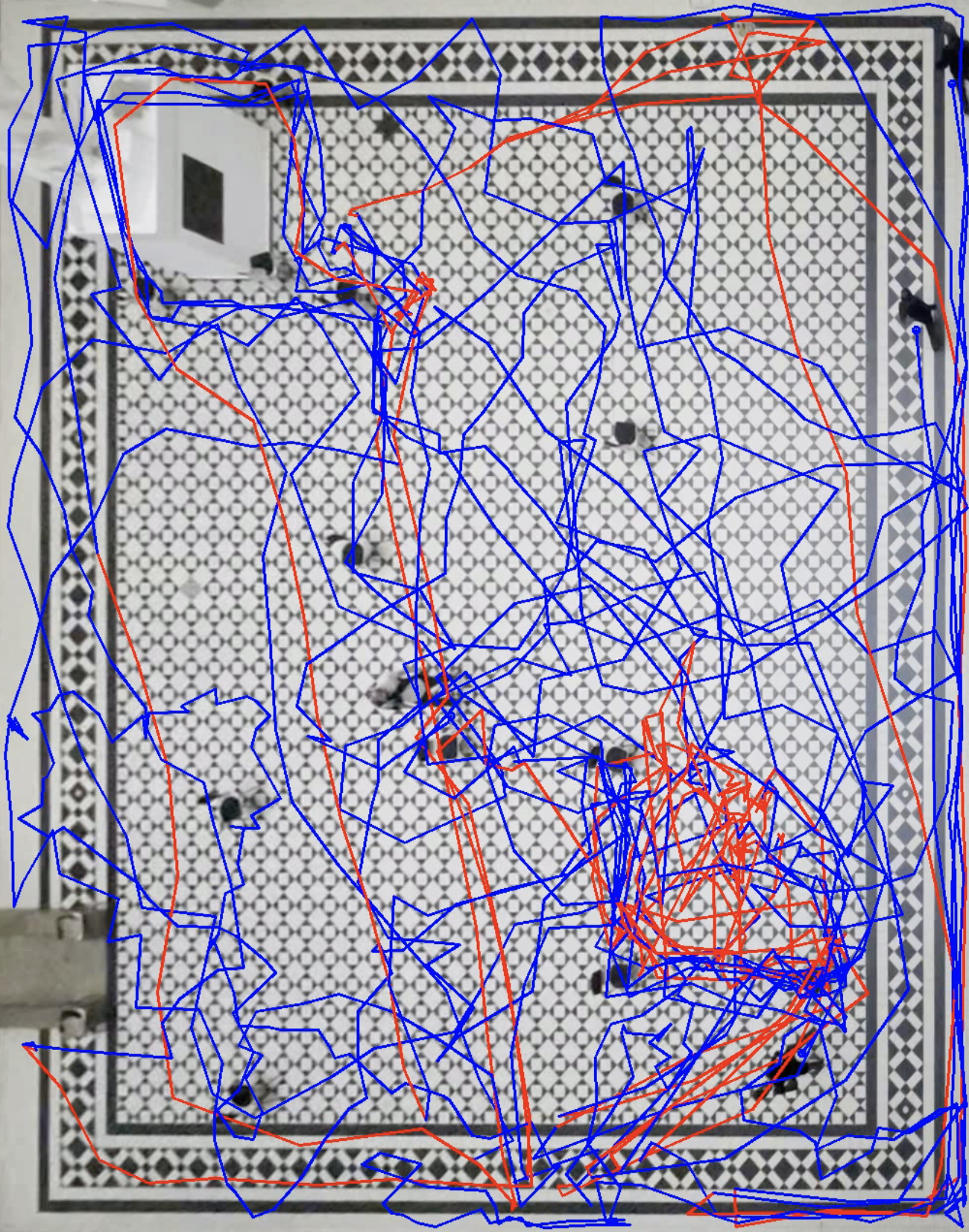
We used Method 2.1: Human simulation of ants in order to encourage the human participants to act more like ants. Our considerations regarding the sensory gap resulted in several rules and design choices for this setup:
- Participants were blindfolded to stop them from getting a visual overview of the playing field and encourage them instead to orient themselves using sound and triangulation. We observed from the sidelines to ensure the participants’ safety.
- Participants were forbidden to speak to stop them from coordinating and strategizing using language. This served to amplify the sensorial experience of interacting with other agents in the same system. Participants were allowed to lead each other by touch, further emphasizing the focus on information exchange by proximity.
- A loudspeaker playing ant sounds was positioned at the nest in order to mimic the layer of directional information which pheromone trails provide for ants. This enabled the participants to find the shortest path back to the nest without vision and with fully established spatial awareness.
Manipulating the sensory experiences of the participants made it possible to invoke the feeling of being part of an ant-like distributed intelligent system, as approved by the feedback of participants.
6.2.3 Experiment 3: Pixel
In this experiment, we recreated the ant sandbox labyrinth digitally. We placed food and obstacles at identical positions to Experiment 1. For food, we used individual pixels rather than seeds. For obstacles, we programmed algorithmic constraints into the code. Using the Ant Colony Optimization algorithm (ACO), a colony of four digital ant agents searched for and depleted the food sources. Our implementation of ACO was adjusted to include a visual interface and a set of parameters and rules to fit our ants as much as possible.
The digital ants explore their environment by moving to an adjacent cell within a grid. The digital agent makes a weighted stochastic (random) decision whether to move one pixel up, down, left or right, based on the value of the adjacent pixels. Digital ants start in search mode, where they search for food. Upon finding a food source, the ant changes to food mode and makes its way back to the nest. The simulation produces very different results based on the parameters described below.
- The base value of a cell is always one and resets each time an agent switches modes. The pheromone value and the visited factor are added to the base value.
- The visited factor decreases with each visit. When an agent visits a cell, this value is halved based on the number of visits. This mechanism discourages visiting cells already explored, especially if they have not detected food or pheromones, thereby promoting the exploration of unvisited cells. The visited factor resets whenever the ant switches modes after finding food or bringing food back to the nest.
- The pheromone value “evaporates” with every decision step by a factor of 0.999. While in food mode, an agent leaves pheromones on each visit by adding base value + 1.5 times the pheromone value.
- In food mode, the ants navigate back to the nest using an implementation of the Dijkstra algorithm (Dijkstra, 1959). If a cell increases the distance to the nest, it receives a diminishing factor of 0.5.
The code is available in our Git repository (InterspeciesResearchCluster).
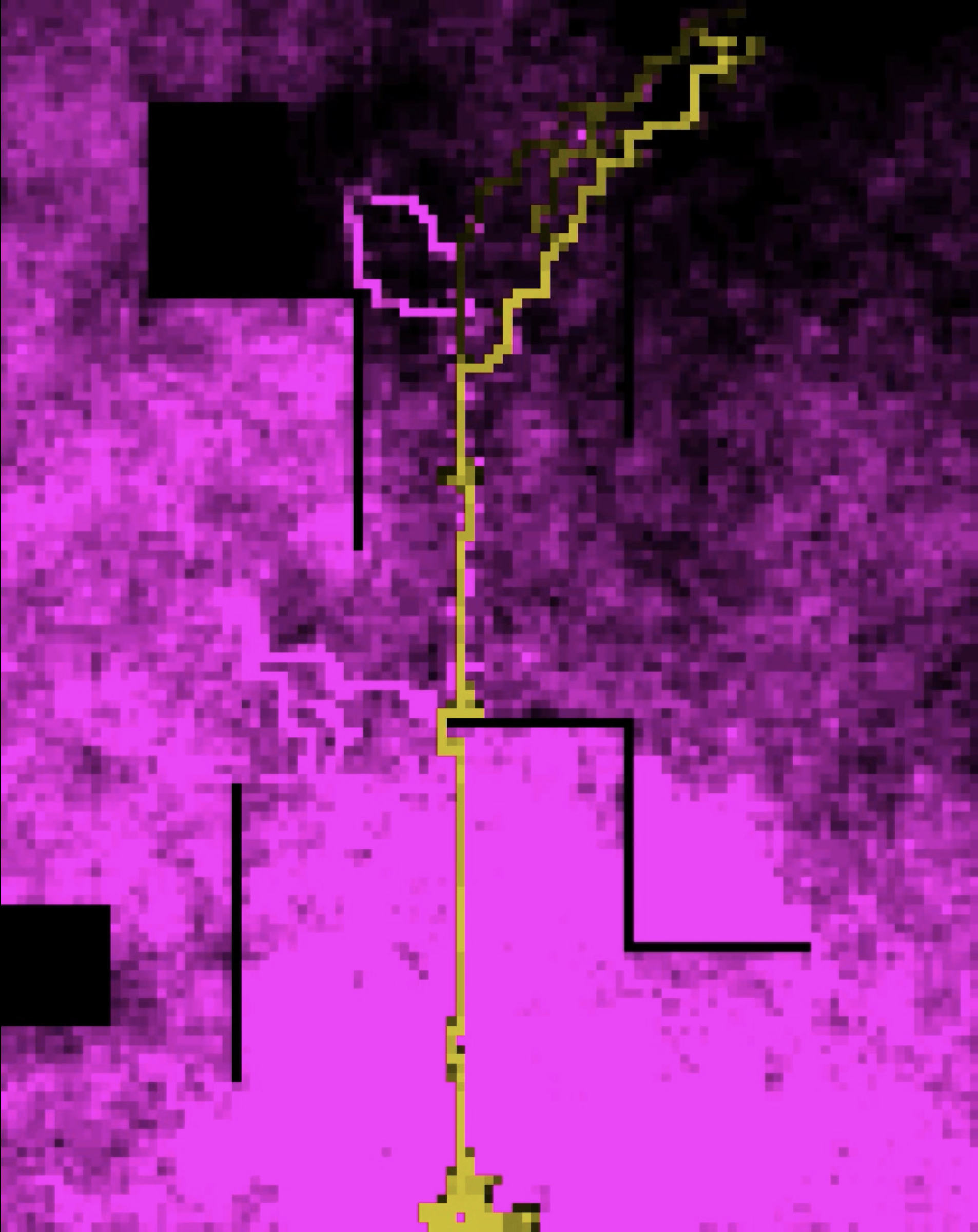
6.3 Observations
These observations come from analysing the ant, human, and algorithmic foraging behavior, walking path data, and informal interviews with the human participants.
6.3.1 Spatial exploration patterns
Ants tended to walk in one direction until they hit an obstacle. They follow the boundary of the obstacle for some time before leaving it completely by walking in another direction (see figure 17). This results in a web of paths inside the sandbox that gets denser over time.
Humans use obstacles as spatial orientation points in space in a different way from the ants. Participants who were informally interviewed post-experiment said that they tried to understand the shape and position of obstacles in relation to the labyrinth. They also tried to make sense of the space they were navigating by building mental images. The ACO agents differed significantly from humans and ants in their exploratory behaviour. They did not use obstacles or walls to orient themselves. Instead, they explored the labyrinth pixel by pixel, similar to a breadth-first search, from closest to the nest to furthest until all food sources were found.
6.3.2 Spatial exploration strategies
All types of agents struggled with obstacle 2 (Figure 21).
The ACO agents get trapped because they try to return to the nest via the shortest path, which cuts directly through obstacle 2. The problem is worsened by the digital ant laying misleading pheromone trails as it tries and fails to escape the obstacle. The moment the visited factor lowers the base value enough, the digital ant can exit this loop and escape the obstacle.
The human agents got trapped inside obstacle 2 for two reasons. Like the digital ants, the humans tried to navigate back using the shortest path by following the sound nest. However, the shape of obstacle 2 requires humans to change direction, travelling for a short time away from the nest. This caused difficulty and confusion among the participants. One participant reported in post-experiment interviews that they thought obstacle 2 was a spiral.
The ants also got trapped in obstacle 2, which is indicated by an increasing number of abandoned seeds, discarded by foragers that got stuck there. We assume that foragers leave heavy seeds behind while trying to escape the obstacle.
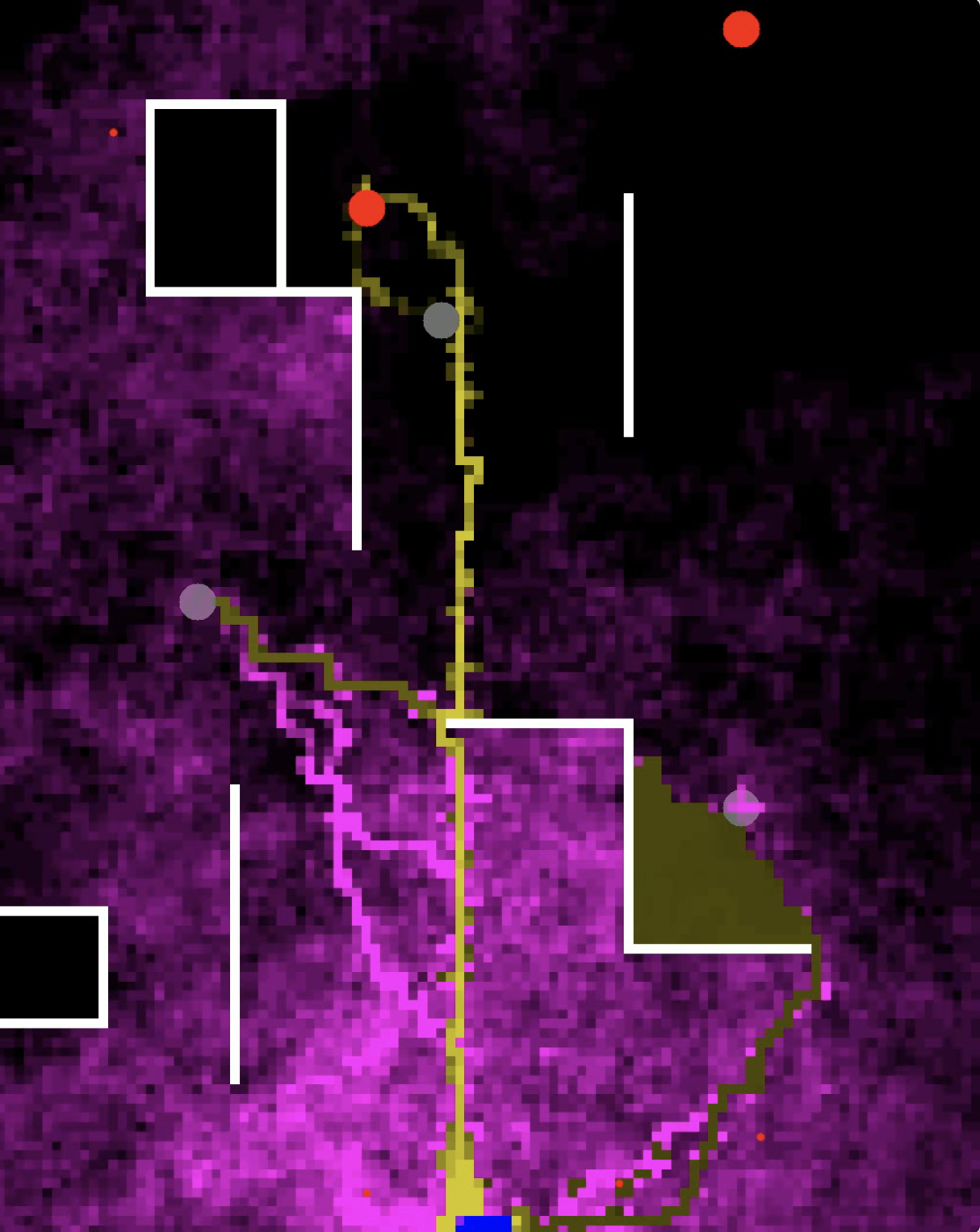
6.3.3 Social interactions
We observed several social interactions amongst humans, and amongst ants.
When ants meet, they communicate by exchanging pheromones using their antennas (see Pheromones / stigmergy). We observed ants using this method to recruit other ants in order to help carry heavy seeds, which was visible in the walking path data.
When human participants met each other, they communicated through physical interactions, despite not being allowed to use spoken language or vocalizations. During the post-experiment interviews, the participants highlighted an improvement in mood, motivation, and orientation after encountering each other. The non-verbal contact helped them overcome boredom with the task and general disorientation.
Social interactions are not usually implemented in ACO algorithms. We believe that the social interactions described above in humans and ants are an essential part of their foraging strategies. This suggests a further investigation of how interaction is, or is not, implemented in future ACO implementations.
6.3.4 Inherent differences between the types of agents
There are several inherent differences between the types of agents, which should be taken into account in interpreting our experiments.
Ants have a large number of agents compared to humans and the ACO. They need to forage for seeds to survive. We assume that they are not aware that they are part of an experiment. In contrast, humans are aware that they are playing a game, which they know has been designed by other humans. They can choose to ignore or break the rules because they don’t need to collect potatoes to survive. The ACO has no concept of death/survival. It is unable to escape the rules of the game and does not expend energy like ants or humans.
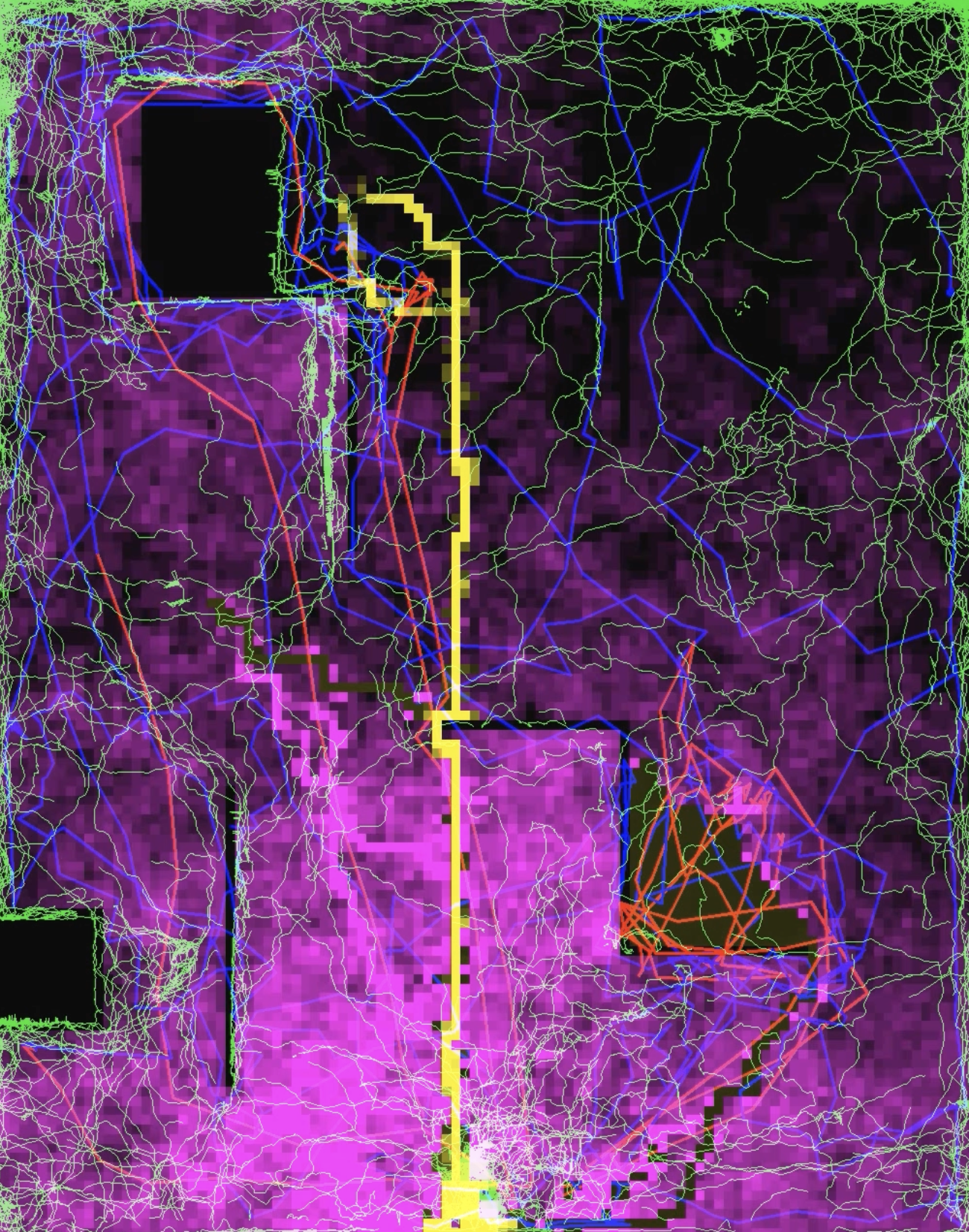
6.4 Conclusions
We evaluate the observations in relation to the initial 3 aims of Seed. Potato. Pixel.
6.4.1 Aim 1: Utilising technology as interspecies interface
We were successful in using technology to bring the worlds of ants, humans, and algorithms into a single medium, so that they could be compared. By projecting their walking paths onto our sandbox labyrinth, we were able to present this comparison visually. From our public exhibitions, we saw that this served as an excellent tool for engaging people with our project.
6.4.2 Aim 2: Comparing patterns and strategies of spatial exploration in foraging
We were able to observe and compare different patterns and strategies in foraging, specifically concerning the differing characteristics of the movements. We were not able to conduct quantitative comparisons of the agents’ performance/success due to a combination of insufficient time/test runs and inherent differences between ants, humans, and algorithms, which would have put the validity of this data into question.
6.4.3 Aim 3: Bringing algorithmic models of animals into conversation with the human model makers and the animals themselves
Through exhibiting Seed. Potato. Pixel., we tried to provoke members of the public to reflect on the relation between the three types of agents. In many cases, this also resulted in discussions about this topic. However, these responses were not formally documented or analysed, due to their preliminary nature.
6.4.4 Walking path data for Messor aegyptiacus
There is a lack of published research regarding Messor aegyptiacus. At the time of writing, only one study by Sheata and Kaschef has analyzed their food-finding strategies. We believe that the data from our computer vision path tracking system could contribute to research on Messor aegyptiacus, and the Messor family in general. Our data suggest that this species does not rely on continuous pheromone trails, or on recruiting large groups of workers, unlike many other ant species such as Lasius niger. This suggests that there may be alternatives to the pheromone-trail inspired ACO algorithms, which use alternative navigation mechanics, e.g., based on social interactions.
On this basis, we consider Seed. Potato. Pixel. to be successful in reaching its initial aims.
6.5 Limitations
Our experiments could be considered limited by scientific standards because they were not conducted under laboratory conditions. Many of our approaches, e.g., for data collection, were informed by existing scientific methods. However, in other areas, we made a conscious decision to compromise on qualities such as reproducibility, to maximise flexibility and freedom in the working process, to express ourselves artistically, and explore the unknown. Overall, we tried to maintain a balance between artistic and scientific work.
We compared humans, ants, and an ACO algorithm by tracking their respective walking paths. One limitation of this strategy is the lack of insight that it gives into the inner worlds of these organisms. How are navigational goals identified or evaluated, and potentially discarded, before any steps are taken? This limitation is especially true for humans, who often perform many stages of cognitive processing and reflection before making a navigational decision. It could also be true for ants, but this cannot be verified. Seed. We only offered one kind of food: seeds. Further insights could be gained if we had provided the ants with different kinds of food sources and observed to what extent they treated them differently. For example, would they deplete sugary food sources quicker, even if they are further away? Additionally, we analysed the ant’s movements by looking only at the total accumulation of walking paths. Instead, we could have tracked their movements over longer periods to analyse daily or weekly patterns in foraging activity.
Potato. We conducted this experiment only once, with four participants. It would be more effective if it were repeated multiple times with different parameters, such as more participants, larger arenas, and an improved system for simulating the pheromone trails. This would likely result in a more robust dataset and allow the uncovering of further patterns.
Pixel. Since the behavior and success of the ACO are highly dependent on certain code parameters, it would be worth experimenting with various settings and versions of the algorithm.
Discussion
7.1 Conclusions
In this section, we reflect on how the overall research project turned out with reference to the initial aims outlined in Aims of the project.
7.1.1 Discovering new ways of interacting / living / thinking with other humans and non-humans
In Seed. Potato. Pixel., we developed a method of interacting with ants by placing food and obstacles in their arena and tracking their resulting walking paths. Although this is a simple technique, we consider it to be very effective and useful in a variety of situations. For instance, the path tracking system was repurposed after the project to track the colony’s health and amount of activity over days, weeks, or months. There is a lot of improvement which could be done in this area to encourage interactions beyond food and walking paths, e.g., with pheromones, vibrations, or by other means. While taking care of the colony, we discovered further modes of interaction, for instance, how to pick up an escaped ant, how to encourage the colony to move to a new nest, or to explore a new arena. We often thought about ants through rhythms of care, such as having to show up on particular days to give them food, or interrupting our project meetings to conduct some urgent maintenance of the formicarium. In this sense, there was no clear split between official research work and caretaking tasks.
7.1.2 Assembling existing terms and types of interspecies relationships
We assembled existing terms and types of interspecies relationships in our literature in State of the Art. In the practical part of the project, we tried to create collaborative interspecies relationships, but ended up questioning whether mutual deliberate collaboration with ants is at all possible. The relationship which we had to the ants was, to some extent, domestic. It didn’t have any of the characteristics of a symbiotic relationship, where one organism cannot live without the other, but could potentially be considered as mutualist, because the ants received care and a better space to live, while we got to study them and think about them in the frame of our masters program.
7.1.3 Updating existing cultural, scientific and technological practices and representations of ants
In Seed. Potato. Pixel., we prototyped a layered representation of ants alongside humans and algorithms. After developing this mode of representation, our work received a lot more engagement, which suggests that it is a potentially valuable tool for communication between academia and the public. With regard to scientific and technological practices, we tried to incorporate insights from new materialistic philosophy into the way we used algorithms and drew plans for scientific experiments. However, it is difficult to evaluate the outcome of this, due to the many other factors that affected our working processes.
7.1.4 Integrate non-humans more deeply into creative and design processes
We believe that this project is a successful example of deep integration of non-humans into a creative/design process. This can be seen most obviously when we make mistakes. For example, in our formicarium design process, we started by using water to create a moat surrounding the formicarium. The ants responded negatively, causing us to change our design to create a safer environment by replacing the water with plexiglass walls. There were also aspects of the ant’s behaviour, like their decision about where to place piles of food, or their graveyard, which we took note of, but it was not always clear what effect this should/could have on the formicarium design process. More generally, we found that the presence of non-humans contributed a significant generative drive throughout the project. We underestimated the extent to which working with non-humans would centralise the role of care in the project, are force us to find other solutions to otherwise normal practices like touring our work at festivals or exhibitions. Sometimes this took us in new and exciting directions, and other times they seemed like obstacles.
As well as integrating non-humans, this project is also about non-humans. As a result, it does not provide many insights into what it could look like to work with non-humans in pursuit of an external goal, e.g., solving a certain problem or designing a product. This is an area which could be explored further.
7.1.5 Utilising technology as interspecies interface
In Seed. Potato. Pixel, we used this as our main strategy and developed a technological interspecies interface using camera tracking and live projection.
7.2 Limitations
7.2.1 Replicating confined surveillancebased formicarium designs
Our project initially aimed to analyze and prototype new types of formicaria. The formicarium built for Seed. Potato. Pixel. was larger and featured an open roof, removing barriers between humans and ants while still maximizing visibility. This design unexpectedly facilitated connections between humans and ants through tracking and visualizing their walking paths. This suggests that technological surveillance in formicaria could enhance interspecies relationships, provided that the surveillance is reciprocal to avoid power imbalances—something we didn’t achieve in this project.
Additionally, our design limited the ants’ ability to explore the outside world. We hope to address this by creating methods for studying ants without full confinement, such as a half inside-outside design that allows observation around their nest.
7.2.2 Impossibility of escaping anthropocentrism and bridging the sensory gap
This limitation points to the fact that escaping anthropocentrism is paradoxical because it involves humans trying to escape their humanness. This can be said for all attempts to understand non-human perspectives/experiences. However, we do not believe that it makes research into non-human perspectives/experiences obsolete, but rather serves as a reminder to always be self-critical and aware of the researcher’s position. It is still possible to imagine and prototype new kinds of experience that go beyond the familiar daily human experiences, while leaving the question open to what extent these experiences are similar to those of other organisms. For example, during our live simulation experiments, we experimented with an additional human acting as a "sensory mediator" for the main human participant. This allowed us to rewire the usual logic of our senses, simply by adding a new "mediation" step, and move the focus from the individual sensing human to a collective group of sensing agents, without any physical alterations to one’s senses.
7.2.3 Conflation of machines with biological organisms like humans and ants
This limitation questions whether it makes sense to extend our research on human-non-human relations to machines, as opposed to treating them as different categories. One response would be to point out that the role of the machine can change drastically depending on context. For instance, ACO algorithms appear to be the direct products of human attitudes/ways of thinking about ants as mechanistic creatures. On the other hand, new developments in Artificial Intelligence point to the fact that we must also find new ways of conceiving computers as autonomous moral agents, like we do for biological organisms. This simultaneous double-nature of machines has similarities with concepts of two-sided domestication, where the organisms involved are both separate and at the same time deeply entangled. We argue that whether or not machines / Artificial Intelligence can be considered an autonomous moral entity, it is important to question our assumptions and find ways of approaching machines critically. Following this, we consider it productive to experiment with conflating these categories and drawing from the existing research on non-humans, in order to better understand (how we interact with) machines.
Acknowledgements
We thank the Design & Computation team, Prof. Albert Lang, Prof. Dr. Marc Pfaff, and Johannes Pointner for mentoring us and providing feedback throughout this project. We thank Chia-Chi Chen (M.A. Design & Computation) for her involvement in the initial phases of the project and for sharing her Arduino/electronics expertise. We thank Prof. Daniel Hromada (Berlin University of the Arts) (Hromada & Kuschel,
2024) for helping us navigate the academic landscape and for his continued support of our project. We thank our fellow students for their participation in our live simulation experiments. We thank Maximilian Prüfer for taking the time to meet with us and sharing his knowledge about ants. We thank Bubbles the cat and all of the ants involved in this project.
9. References
Aesop. (n.d.). The ant and the grasshopper. (Perry Index #373)
Antkeepers.com. (2016, April). Lasius niger (black garden ant). https://web.archive.org/web/20160412165220/https://www.antkeepers.com/ant-species/lasius-niger. (Archived version, accessed March 28, 2025)
AntsCanada. (n.d.). AntsCanada on YouTube.https://www.youtube.com/user/AntsCanada. (YouTube channel. Accessed April 4, 2025)
ANTSHQ. (n.d.). Antkeeping, at home. https://www.antshq.co.uk/ants-shop-draft. (Accessed March 25, 2025)
ANTSTORE. (n.d.). Ants. https://www.antstore.net/shop/en/ants/. (Accessed March 25, 2025)
Baltzersen, R. K. (2021). Cultural-historical perspectives on collective intelligence: Patterns in problem solving and innovation (1st ed.). Cambridge University Press. (Accessed March 26, 2025) doi: 10.1017/9781108981361
Bayerischer Rundfunk. (n.d.). Der mit den ameisen malt: Wie maximilian prüfer mit der natur kunst macht.https://www.br.de/beitrag/maximilian-pruefer-ameisen-kunst-100.html.
Beverly, B. D., McLendon, H., Nacu, S., Holmes, S., & Gordon, D. M. (2009). How site fidelity leads to individual differences in the foraging activity of harvester ants. Behavioral Ecology, 20(3), 633–638. (Accessed March 24, 2025) doi: 10.1093/beheco/arp041
Bostan, B., & Aker, Ç. (2022). Using Heuristics for Evaluating Game Narrative: A Close Reading of Death Stranding. In B. Bostan (Ed.), Games and Narrative: Theory and Practice (pp. 299–314). Cham: Springer International Publishing. doi: 10.1007/978-3-030-81538-7_19
@chasseurdesons. (2025). The sounds of an anthill [#ants #science]. Social media post. Retrieved from https://www.youtube.com/watch?v=byxK0RxWxY0&ab_channel=CHASSEURDESONS (Accessed March 25, 2025)
Chen, J., Rashid, T., Feng, G., Zhao, L., Oi, D., & Drees, B. B. M. (2013, December). Defensive chemicals of tawny crazy ants, Nylanderia fulva (Hymenoptera: Formicidae) and their toxicity to red imported fire ants, Solenopsis invicta (Hymenoptera: Formicidae). Toxicon, 76, 160–166. doi: 10.1016/j.toxicon.2013.09.018
Chen, Y.-H., & Robinson, E. J. H. (2013, August). A comparison of mark– release–recapture methods for estimating colony size in the wood ant Formica lugubris. Insectes Sociaux, 60(3), 351– 359. doi: 10.1007/s00040-013-0300-z
Dijkstra, E. W. (1959, December). A note on two problems in connexion with graphs. Numerische Mathematik, 1(1), 269–271. doi: 10.1007/bf01386390
Dong, A. Z., Cokcetin, N., Carter, D. A., & Fernandes, K. E. (2023, July). Unique antimicrobial activity in honey from the Australian honeypot ant ( Camponotus inflatus ). PeerJ, 11, e15645. doi: 10 .7717/peerj.15645
Dorigo, M., & Di Caro, G. (1999). Ant colony optimization: A new meta-heuristic. In Proceedings of the 1999 Congress on Evolutionary Computation-CEC99 (Cat. No. 99TH8406) (pp. 1470–1477). Washington, DC, USA: IEEE. doi: 10.1109/CEC.1999.782657
Drake, F. (1965). THE RADIO SEARCH FOR INTELLIGENT EXTRATERRESTRIAL LIFE. In Current Aspects of Exobiology (pp. 323–345). Elsevier. doi: 10.1016/B978-1-4832-0047-7.50015-0
Dreyer, T., Haluts, A., Korman, A., Gov, N., Fonio, E., & Feinerman, O. (2025, January). Comparing cooperative geometric puzzle solving in ants versus humans. Proceedings of the National Academy of Sciences, 122(1), e2414274121. doi: 10.1073/pnas.2414274121
eBay. (n.d.). Ants on ebay. https://www.ebay.com/sch/i.html?_nkw=live+ants&_sacat=158699&_from=R40&_trksid=p2334524.m570.l1313. (Accessed March 25, 2025)
Ellison, A. M., & Gotelli, N. J. (2021). Ants (hymenoptera: Formicidae) and humans: From inspiration and metaphor to 21st-century symbiont. Myrmecological News, 31, 225–240. Retrieved from https://doi.org/10.25849/MYRMECOL.NEWS_031:225 (Accessed May 29, 2024) doi: 10.25849/MYRMECOL.NEWS_031:225
Freas, C. A., & Spetch, M. L. (2024, January). Route retracing: Way pointing and multiple vector memories in trailfollowing ants. The Journal of Experimental Biology, 227(2), jeb246695. doi: 10.1242/jeb.246695
Gordon, D. (1999). Ants at work: How an insect society is organized. New York, NY: Free Press.
Gordon, D. M. (1993, October). The spatial scale of seed collection by harvester ants. Oecologia, 95(4), 479–487. doi: 10.1007/BF00317431
Gordon, D. M. (1996, March). The organization of work in social insect colonies. Nature, 380(6570), 121–124. doi: 10 .1038/380121a0
Gordon, D. M. (2010). Ant Encounters: Interaction Networks and Colony Behavior. Princeton University Press. doi: 10.1515/9781400835447
Gordon, D. M. (2023a). Collective behavior in relation with changing environments: Dynamics, modularity, and agency. Evolution & Development, 25(6), 430–438. doi: 10.1111/ede.12439
Gordon, D. M. (2023b). The ecology of collective behavior. Princeton Oxford: Princeton University Press.
Gordon, D. M., Steiner, E., Das, B., & Walker, N. S. (2023, September). Harvester ant colonies differ in collective behavioural plasticity to regulate water loss. Royal Society Open Science, 10(9), 230726. doi: 10.1098/rsos.230726
Gould, W. (1747). An account of English ants : Which contains I. Their different species and mechanism. II. Their manner of government, and a description of their several queens. III. The production of their eggs, and process of the young. IV. The incessant labours of the workers or common ants : With many other curiosities observable in these surprising insects. London: Printed for A. Millar. doi: 10.5962/bhl.title.168572
Guggenheim Museum. (2017, May). The hugo boss prize 2016: Anicka yi, life is cheap. https://www.guggenheim.org/exhibition/anicka-yi-life-is-cheap.
Hager, F. A., & Krausa, K. (2019, March). Acacia Ants Respond to PlantBorne Vibrations Caused by Mammalian Browsers. Current Biology, 29(5), 717-725.e3. doi: 10.1016/j.cub.2019.01.007
Haraway, D. (2016). Staying with the trouble: Making kin in the Chthulucene. Durham London: Duke University Press.
Haraway, D. J. (2003). The companion species manifesto: Dogs, people, and significant otherness (No. 8). Chicago: Prickly Paradigm Press.
Hevesi, D. (2011, January). Milton M. Levine, Inventor of Ant Farm, Dies at 97. The New York Times, 23.
Horsman, D., Kendon, V., Stepney, S., & Young, J. P. W. (2017). Abstraction and Representation in Living Organisms: When Does a Biological System Compute? In G. Dodig-Crnkovic & R. Giovagnoli (Eds.), Representation and Reality in Humans, Other Living Organisms and Intelligent Machines (Vol. 28, pp. 91–116). Cham: Springer International Publishing. doi: 10.1007/978-3-319-43784-2_6
Hromada, D., & Kuschel, L. (2024, July). SHORT PLAIDOYER FOR INTRODUCTION OF ECOARTIFICIAL EDUCATION IN DIVERSE CURRICULAR SYSTEMS OF THE PLANET EARTH. In 16th International Conference on Education and New Learning Technologies (pp. 6008–6014). Palma, Spain. doi: 10.21125/edulearn.2024.1434
Interspecies Internet. (n.d.). Interspecies internet.https://www.interspecies.io/. (Accessed: 2025-04-04)
Interspecies Research Cluster. (2025a, March 4). Ant human manifesto sim. https://www.youtube.com/watch?v=zvcYWrzlYaM. (YouTube)
Interspecies Research Cluster. (2025b). seed potato pixel. https://www.youtube.com/watch?v=bE2mdI3X8JE&ab_channel=InterspeciesResearchCluster. (YouTube video)
InterspeciesResearchCluster. (2025). Cv ant tracking. (Interspecies Research Cluster project)
Kagen, M. (2022). Wandering Games. The MIT Press. doi: 10.7551/mitpress/13856.001.0001
Keeling, D. M. (2017, May). Feral Rhetoric: Common Sense Animals and Metaphorical Beasts. Rhetoric Society Quarterly, 47(3), 229–237. doi: 10.1080/02773945.2017.1309905
Kehl, S. (2024, December). Kehl: Kampf gegen die Ameise. https://www.kehl.de/ameisenplage.
Kirby, W., & Spence, W. (1857). An introduction to entomology: Or, elements of the natural history of insects, comprising an account of noxious and useful insects, of their metamorphoses, food, stratagems, habitations, societies, motions, noises, hybernation, instinct, etc., etc. Longman, Brown, Green, Longmans & Roberts.
Lasseter, J. (1998). A bug’s life. Film; co-directed by Andrew Stanton; Pixar Animation Studios and Walt Disney Pictures. Retrieved fromhttps://www.imdb.com/title/tt0120623/ (Accessed March 25, 2025)
Loncraine, J. (2017). Attenborough and the empire of the ants. Film; presented by David Attenborough; BBC. Retrieved fromhttps://www.imdb.com/title/tt7830168/ (Accessed via IMDb on March 25, 2025)
Lynch, D. (2009). Lynch on lynch (2nd ed.; C. Rodley, Ed.). London: Faber Faber.
MacMahon, J. A., Mull, J. F., & Crist, T. O. (2000, November). Harvester Ants ( Pogonomyrmex spp.): Their Community and Ecosystem Influences. Annual Review of Ecology and Systematics, 31(1), 265–291. doi: 10.1146/annurev.ecolsys.31.1.265
Menke, S. B., Booth, W., Dunn, R. R., Schal, C., Vargo, E. L., & Silverman, J. (2010, February). Is It Easy to Be Urban? Convergent Success in Urban Habitats among Lineages of a Widespread Native Ant. PLoS ONE, 5(2), e9194. doi: 10.1371/journal.pone.0009194
Meyer-Brandis, A. (n.d.). One Tree ID.
Meyer-Brandis, A. (2011). Moon Goose Colony: Video Documentation.
NASA. (1977). Voyager golden record. https://voyager.jpl.nasa.gov/golden-record/. (Phonograph record included with Voyager 1 and 2 spacecrafts)
New Practice in Art and Technology. (n.d.). Loops. https://www.newpractice.net/loops.
Noda, C., Fernández, J., Pérez-Penichet, C., & Altshuler, E. (2006, December). Measuring activity in ant colonies. Review of Scientific Instruments, 77(12), 126102. doi: 10.1063/1.2400215
O’Fallon, S., Drager, K., Zhao, A., Suarez, A., & Pinter-Wollman, N. (2023, August). Foraging behaviour affects nest architecture in a cross-species comparison of ant nests. Philosophical Transactions of the Royal Society B: Biological Sciences, 378(1884), 20220146. doi: 10.1098/rstb.2022.0146
OpenCV. (2015). Open Source Computer Vision Library.
Pacific Invasive Ant Toolkit (PIAT). (n.d.). PIAT – Pacific Invasive Ant Toolkit. https://www.piat.org.nz/index.php?page=impacts-of-invasive-ants. (Accessed April 4, 2025)
Paluh, D. J., Riddell, K., Early, C. M., Hantak, M. M., Jongsma, G. F., Keeffe, R. M., . . . Blackburn, D. C. (2021, June). Rampant tooth loss across 200 million years of frog evolution. eLife, 10, e66926. doi: 10.7554/eLife.66926
Qin, Z., Zhao, Q., Choiniere, J. N., Clark, J. M., Benton, M. J., & Xu, X. (2021, August). Growth and miniaturization among alvarezsauroid dinosaurs. Current Biology, 31(16), 3687-3693.e5. doi: 10.1016/j.cub.2021.06.013
Reeves, D. D., & Moreau, C. S. (n.d.). The evolution of foraging behavior in ants (Hymenoptera: Formicidae). doi: 10.26049/ASP77-2-2019-10
Schultheiss, P., Nooten, S. S., Wang, R., Wong, M. K. L., Brassard, F., & Guénard, B. (2022, October). The abundance, biomass, and distribution of ants on Earth. Proceedings of the National Academy of Sciences, 119(40), e2201550119. doi: 10.1073/pnas.2201550119
Schwarz, M., Yang, A. L., & Hamburger, K. (2024, April). The human sense of smell in spatial orientation: A state-of-theart review. Psychology of Consciousness: Theory, Research, and Practice. doi: 10.1037/cns0000395
Shannon, C. E. (1948, July). A Mathematical Theory of Communication. Bell System Technical Journal, 27(3), 379–423. doi: 10.1002/j.1538-7305.1948.tb01338.x
Sharma, K. R., Enzmann, B. L., Schmidt, Y., Moore, D., Jones, G. R., Parker, J., . . . Ray, A. (2015, August). Cuticular Hydrocarbon Pheromones for Social Behavior and Their Coding in the Ant Antenna. Cell Reports, 12(8), 1261–1271. doi: 10.1016/j.celrep.2015.07.031
Sheata, M. N., & Kaschef, A. H. (1971, December). Foraging activities ofMessor aegyptiacus emery (Hym., Formicidae). Insectes Sociaux, 18(4), 215–226. doi: 10.1007/BF02223176
Sleigh, C. (2001, March). Empire Of The Ants: H.G. Wells and Tropical Entomology. Science as Culture, 10(1), 33– 71. doi: 10.1080/09505430020025492
Sleigh, C. (2003). Ant. London: Reaktion.
Sleigh, C. (2007). Six legs better: A cultural history of myrmecology. Baltimore: Johns Hopkins university press.
Sleigh, C. (2025, February). How Ants Made SociobiologyCybernetics and the Organicist Tradition. Historical Studies in the Natural Sciences, 55(1), 71–73. doi: 10.1525/hsns.2025.55.1.71
Sosiak, C. E., & Barden, P. (2021, January). Multidimensional trait morphology predicts ecology across ant lineages. Functional Ecology, 35(1), 139–152. doi: 10.1111/1365-2435.13697
Stewart, S. (1993). On Longing: Narratives of the Miniature, the Gigantic, the Souvenir, the Collection. Duke University Press. doi: 10.1515/9780822378563
Them! (1954). Retrieved fromhttps://en.wikipedia.org/wiki/Them!
Triplehorn, C. A., Johnson, N. F., & Borror, D. J. (2005). Borror and DeLong’s introduction to the study of insects (7th ed ed.). Australia: Thomson, Brooks/Cole.
Upton, B. (2017). Situational Game Design (1st ed.). Boca Raton, FL : Taylor & Francis, CRC Press, 2018.: A K Peters/CRC Press. doi: 10.1201/b21655
Veldman, F. (n.d.). Parliament of Things — Into Latour and his philosophy.
Ward, P. S., & Fisher, B. L. (2016, July). Tales of dracula ants: The evolutionary history of the ant subfamily Amblyoponinae (Hymenoptera: Formicidae). Systematic Entomology, 41(3), 683–693. doi: 10.1111/syen.12186
Wells, H. G. (1905). The empire of the ants. (Short story)
Wilson, E. O. (1953, June). The Origin and Evolution of Polymorphism in Ants. The Quarterly Review of Biology, 28(2), 136–156. doi: 10.1086/399512
Wong, M. K., Economo, E. P., & Guénard, B. (2023, February). The global spread and invasion capacities of alien ants. Current Biology, 33(3), 566- 571.e3. doi: 10.1016/j.cub.2022.12.020
Wright, W. (1991). Simant: The electronic ant colony. Computer software. Maxis. (Original release for MS-DOS and Macintosh)
Wysocki, C., & Preti, G. (2009). Pheromones in Mammals. In Encyclopedia of Neuroscience (pp. 625–632). Elsevier. doi: 10.1016/B978-008045046-9.01706-X
Yi, A. (2017). Life is Cheap [Exhibition].
Echoes of the Anthill — Manifesto
In an age reconfigured and muted by screens—vast and unyielding—the ant persists through its cyclical routes: a primordial intelligence weaving subterranean networks beneath the pulse of modernity. "Go to the ant, thou sluggard; consider her ways, and be wise." From this proverb, we initiate a trialogue—a communion drawing together human, ant, and machine. Here, intelligence emerges not from hierarchy but through encounters, as each intertwines its knowledge into a neighboring tapestry, “woven from a zillion of ant acts.”
Our impulse is often to craft environments for the miniature, to frame and contain what we can't easily comprehend. Yet, the gigantic—the overwhelming forces of nature and history—cannot be so easily enclosed; instead, it envelops us, becoming our environment and swallowing us whole. Ants, innumerable and indistinct, live without reference to humanity. Their complex societies, devoid of humanoid intelligence, challenge our presumed preeminence, revealing an "otherness" that both fascinates and unsettles us. The ant, the other, the outsider—all possess the potential to overwhelm the singular "one," disrupting our illusions of control.
Three clusters of ants' organization- ants, colonies, and populations -when picked apart push us to see their liminal linkages of nature-culture. "Colony" is a word rich with ambiguity, bridging the realms of European imperialism and the social structures of ants. This duality invites us to reflect on notions of dominance and subjugation in human history and our interpretation of Earth. Just as explorers once believed that unfamiliar landscapes could be tamed and made to feel like home, we often assume that the natural world exists for our domestication and that everything is in order and comprehensible. Yet, this presumption overlooks the vast scales and complexities beyond our immediate perception. We construct gardens, zoos, and other curated sites—eccentric imitations designed to frame our experience of nature, monuments to its metamorphosis into capital.
This manifesto aberrational act of humility, challenging the very boundaries of thought, perception, and sense. Our inquiry draws us into an ecosystem of connections, an arena of shared sensations—the unseen net of interdependence we so often ignore. Ants reveal the profound symbiosis of all things, a network of exchanges that upholds us as much as it sustains them.
This is not a quest for dominance but an embrace of mutual becoming—a vision of coexistent intelligences weaving new networks of shared potential.
Let us regard the ants not as objects of detached novelty but as co-creators in a web of dynamic exchange. Abandoning the myth of human exceptionalism, we must recalibrate towards the symbiotic frequencies resonating across species, systems, and scales. By embracing this alien kinship, we open ourselves to a techno-material dialogue—a speculative praxis where intelligence, organic and synthetic, evolves through collaboration rather than conquest.
Futuristic Ant Fiction
I let myself be guided through the forest. I place my feet very slowly and carefully on the moss. I don‘t want to trample anyone, even though my Ai shows me exactly that all the ants are giving me a wide berth as usual. Right now, I‘m surrounded by several billion ants that are guiding me through the forest in a wave of crawling legs. All of us ping a friendly conversation back and forth with our Ai‘s (ants have an excellent black sense of humor), but as soon as I accidentally crush one of them, they are allowed by law to eat me. I‘m sweating a bit, but since no one wants to be trampled either, we‘ve found a good rhythm.
They take me to a fat oak tree. The oak is littered with porcini mushrooms and smells particularly musty, even for fall weather. The ants bombard my Ai with information about the forest, soil, trees, mushrooms, woodpeckers, weather, worms, stones, branches, lichen, jays, bark, mistletoes and nettles. I stand waiting while the Ai’s negotiate. Then they translate what the ants want: they want me to cut down the tree. I don‘t quite understand how that helps the health of the forest, but it’s not like I need to. That‘s ant business.
I turn to the tree, release the strap from my shoulder and grip my chainsaw firmly with both hands. I let it roar, send out a loud warning sound with the Ai and the ants scurry off in all directions. Then I step forward and fell the oak tree. It hits the forest floor, groaning loudly and dramatically. For a moment, the entire forest seems to hold its breath, then billions of tiny ant legs crawl through the forest towards the tree, completely enveloping it with their shiny bodies. The birds start singing again and I wave my aching arms until a pack of ants surrounds me and leads me through the forest back to the forester‘s lodge on the edge of town. I wave to them at the foot of the doorstep and they write ‚see you soon‘ with their dark bodies on the pale stone path in front of the house.
It‘s clear. The human queen turns to the man and raises her hand resolutely. Her ai sends the sentence into the courtroom, a murmur rumbles through the room and the man turns pale. “But they were almost in my house,” he babbles quietly, ”that was actually self-defense, wasn‘t it? It‘s illegal for them to come into my house, I was just following the law.” He speaks silently to himself and his ai flickers nervously, but the 7000 ants who have testified against him pay no attention to him. The human witnesses do the same as the ants: they all ignore the man and watch the ant queen on the pedestal next to the human queen. She is as big as a cat and emits a dark clicking sound. The presence of her ai is soft and wise and she does the same as her sister queen: she finds the ant killer seven times guilty. The murmur in the room grows louder, the man falls silent and looks down at the floor. He knows what is coming, just like everyone else in the room, and every single ai, every consciousness stares ahead, spellbound, so as not to miss a single moment of the royal punishment ritual.
The human queen raises her hands to the sky and the room falls silent. She slowly brings the fingers of her left hand to her forehead and touches the skin between her eyes. The ant queen begins to hum in a deep bass and the ais of the ants in the room sparkle brightly gold in response. An infinite number of ant legs pitter-patter excitedly. The human queen spreads the fingers of her right hand high up in the air, then twitches downwards in an elegant movement and touches the vibrating ant queen‘s head with her index finger. With an equally quick movement, the cat-sized ant jumps forward and lands on the man‘s head. He screams, throws himself to the ground and is bitten on the side by the queen. The two royal ais flood the man with the royal virus: his ai is reset and now he has to take part in the training for untrained baby ais. Normally, the human consciousness, which will later cooperate with the ai, is not part of this training. And for good reason: it’s emotionally brutal. But now both parts of this body‘s consciousness must be prepared for their punishment as quickly as possible. There is no room for consideration.
The royal virus reminds the man of the reason for the cooperation between ants and humans: the earth is dying. The garbage, the plastic, the humans have brought the earth to the edge of its limits, ensuring that all life on earth is doomed. The man cries quietly. He experiences the fear, the powerlessness, the anger, the despair, the self-hatred of the people of that time. He is confronted with the hopelessness of human ignorance and writhes under the guilt that he too carries from his past behavior.
The royal virus switches to the next training phase: realization. On the brink of Earth‘s irrevocable collapse, humans have finally understood that the solution to their problems lies with the ants. The ais of futurology back then all agreed: ants can analyze the Earth and its needs with a speed and all-encompassing accuracy that is beyond the human intellect. Humans, on the other hand, are masters at developing technologies and changing their environment on a large scale. In all future scenarios, the global and equal cooperation between humans and ants has led to saving the earth and stabilizing the climate. The man is panting, kneeling on all fours on the ground, eye to eye with the ant queen. He looks at her enchanted, as if he has never seen a creature like her before. The corners of his mouth turn upwards cautiously, his eyes are wide. The nervous hope of the people from back then makes him tremble.
The royal virus breaks the moment with the last part of the training. The man‘s ai is fully reactivated. It is now programmed according to the requirements of the intergalactic network of artificial intelligences - because the punishment for the sevenfold ant murderer is the highest punishment of the royal court: exile. The man has trampled on the inviolable peace agreement between ants and humans and can no longer be part of the community of life on Earth. He will leave Earth and help the ais in their exploration and colonization of the universe. Natural intelligences and organic bodies are highly respected in outer space, and the most favorite thing for them to observe and study meticulously there. Humans and ants are regarded by the ais as living ancestors and are particularly popular. He will be allowed to do whatever he wants. Except return to earth.
The man cries again, but he does not protest. He understands, he accepts, and he misses Earth already. His last wish is to go swimming naked in a cold, clear mountain lake at sunrise, for one last time. The queen sisters grant it.
Verknüpfungen
- Inhaltlich verbunden mit Seed.Potato.Pixel